
This review ended up being so sprawling because of the amount of thoughts I’ve had on it that I’ve had to divide it up into different sections. I regret absolutely nothing about this because I love the sound of my own voice…
The Preamble
It took me damn near a year and a half to actually finish Baldur’s Gate 3 in order to write something about it, but in the name of all the Good deities of the Forgotten Realms, I finally finished it at the beginning of this year. Amusingly enough, I then happened to complete it a second time less than a month later, which I think might provide some relatively unique insight here.
Let me give you a little context for this before I actually explain my thoughts on the game.
You see, my friends and I bought BG3 more or less upon release and we set out into the world of the Forgotten Realms as a quartet. For this campaign, we each created a new original character (not to be confused with “origin characters” who are the pre-made and story-driven companions of the game). We also smashed Act 1 and 2 of the game in the space of about 3 months and it then took another 12 months to drag ourselves through the first 10% of Act 3, followed by a final sudden rush through the final act of the game in the early months of 2025.

I had initially promised myself that I would start a solo playthrough of BG3 after finishing it with the boys. Naturally this was so I could do it “properly” after those retards messed everything up along the way. But after the long drought of the multiplayer campaign I bit the bullet of starting my singleplayer game towards the end of 2024.
All of this is to say that I now have the perspective of someone who has completed the game both solo (and properly) and while chasing a group of orangutans who skip dialogue and cut-scenes, who steal everything that isn’t nailed down and occasionally get in fights with just random guardsmen for no reason. Pretty polar-opposite experiences.

Starting with the basics, Baldur’s Gate is an isometric RPG hailing from a time when isometric RPGs were the only way to make them and not because it’s “retro”. Really, it’s hard to overstate how influential Baldur’s Gate is as a series given that it wouldn’t be totally unfair to say that Baldur’s Gate is “Dungeons and Dragons the video game”. By which I don’t mean “it’s like they made a video game of DnD”. No, I mean… Legit… It’s like THE video game of DnD. I didn’t know this prior to playing BG3 myself, so forgive me for the tangent.
The previous two games are actually something I only ever scratched the surface of, and I mean this literally, given that I have unfond memories of being unable to complete the tutorial of Shadows of Amn when I was 9 or 10. But I am fully aware that these are games which practically DEFINED the genre.
Thankfully BG3 was in the rather safe hands of Larian Studios and I think it’s pretty equally safe to say that they somewhat knocked it out of the park. I mean, most of this is almost certainly not news to you. BG3 was an internet darling even prior to release from early access. It sold obscene amounts of copies and has had accolades heaped on it from literally every single angle. While it’s been years since I had played enough games to do an awards post, I will add here that it was easily my Game of the Year for 2023, beating out stuff like Phantom Liberty, Dredge and Hogwarts Legacy (lol).
So, I’m fairly confident that a lot of the praise I am about to lavish on the game has all been said a thousand times before… BUT now with the added context that I have also seen Baldur’s Gate in what must be one of its worst configurations. I do also think it’s important to say here that while I love it, the game is flawed as fuck in some notably big ways and in some ways specific to me.
Downsides of the mechanics
Let’s start with something which is a little bit earth-shattering. Turns out, none of the four of us (myself and the guys I played with) like DnD… Well, this isn’t strictly true because we’re not super experienced in actual real-life DnD, but certainly there were aspects of BG3 which all three of us did not like and it usually seemed to come about that these were mechanics which had been directly translated from DnD.
Most egregious of this is the armour/health and stat system, which is also intrinsically tied to the loot system. First of all, none of us really like the “armour save” mechanic. A creature has a certain amount of armour and when you attack it, dice are rolled to determine whether or not you do damage. If you exceed the armour amount, you do damage (and the game rolls again for damage) if you don’t exceed it, you “miss”. This is in stark contrast to the WoW school of armour or the Divinity school of armour. In the WoW school, armour contributes either a flat or percentage reduction to the amount of damage you take to your health. While in the Divinity school, armour is an additional health bar which must be broken before you actually start dealing damage to health.

Now, I don’t strictly want to say any one system is worse or better, but the big disadvantage to DnD armour saves (and in fact this extends to the whole stat save system, like rolling wisdom or strength saves on certain spells) is what it does to the loot system. Bear with me here as I use the example of heavy armour for classes like clerics, paladins and warriors. From the absolute start of the game, this armour has a minimum armour class of 14. The end-game legendary and “best” heavy armour in the game has an armour class of 21. This means that across a 3 Act game which can exceed 100 hours of play time, your armour class will increase 7 points… But even that isn’t true. There are other epic and rare suits of armour which can be found relatively early on, including another of the best suits of heavy armour in the game which has an AC of 18 within the first 20 hours.
I THINK the rationale of this system seems like an attempt at “realism”: if you’re wearing a massive set of fuck-off armour, if someone else has an even just has a moderately normal and non-fuck-off-sword, quite frankly it’s still plausible to get hurt if you get whacked with it. So “armour saves” are an attempt at balancing the realism that even an ordinary Joe could stab a level 20 dragon to death, given that he got SUPER lucky with the right angles and timing.
This is an overly verbose way to express that essentially, getting loot in Baldur’s Gate often SUCKS because of how minute the scaling seems to be. When you get a new set of legendary gear in the Witcher or something, you could FEEL the difference in power. When you get a new incredible piece of armour in BG3, it has the exact same base stats as the same armour you’ve had for the last 40 hours except now you have to choose between one which gives you a plus 1 fire damage when you scratch your arse and one which gives you the option to pick your nose as a free action during combat.

To be clear, I hate the awful loot systems of games like the new Assassin’s Creeds where you will get three new upgrades for your gear every level and so-called “Legendary” weapons will last you for 30 minutes before you find a new upgrade on a dead peasant in the next area. But BG3 feels like it goes to a vast opposite extreme where you can find gear in the first hour of the game and then basically not change it for the next 100 hours. And that just kind of sucks…
Loot for us is a FUN part of RPGs. Feeling yourself get stronger both through levels but also regularly upgrading your gear to become an absolute monster is just an enjoyable experience, and it really is so depressing that you don’t really get much like this in BG3. I’m sure of course there are some sweaty synergies which can be made between the arse-scratching armour and the arse-fingering ring you found 30 hours beforehand, but for the most part I genuinely felt like any time I “upgraded” my armour it was really completely based on vibes rather than it actually being any better (as-in I just thought that a particular wizards hat sounded slightly neater than my current one).
This was an opinion shared by my friends that essentially it felt like there was such minimal progression, which is a bit of a disappointment in an RPG where growing more powerful is often actually a core part of the experience. Here the only progression was levelling, which to be honest also often didn’t feel that exciting for very similar reasons. Your base stats never increase, there’s a pretty strict limit on the spells you have access to, and things like feats felt very difficult to pick not because you wanted all of them but because they all sounded equally “meh”.

This same issue also stretched from armour to abilities where it felt like often there were certain abilities which were just straight up the best options (usually the ones which did the most damage) and then there were many others which just seemed kind of pointless. Many of the status effect abilities like fear/polymorph and others relied on passing skill checks which meant that they would fail more often than succeed. This meant that experimenting with the variety of spells and abilities available often seemed an exercise in futility in the face of just using the spell that did the most damage. This meant that for some characters (for example Jroy playing a dwarven cleric) after level 7 most fights became routine because he’d be doing the exact same sequence of spells each time.
It’s possible that some of these spells would be much more fun in an actual DnD setting, but certainly in the hard boundaries of a video game, many of the more “unusual” spells felt like a risk to pick instead of using “smite the enemy for extra damage”.
And as another aside there, playing as a bard myself, I have to say it was quite disappointing how few of the spells actually felt like “bard spells” as opposed to just me just playing another generic spellcaster.

The absolutely WORST part of the ability system though was the concentration mechanic though… This was a genuine misstep. Essentially, there are certain spells which functioned over time (e.g. buffing your teammates dice rolls for several turns), these require a character to “concentrate” on that spell. Every character can have one spell they are “concentrating” on and still do normal actions. However, if they get hit/stunned/anything, there is a chance to lose concentration, causing the spell to cancel.
Neat idea, terrible in practice. First off, it means that in a whole spellbook it’s never worth having multiple concentration spells at once, as you can only ever have one active. Secondly, even with the Feat to make it easier to maintain concentration, getting interrupted is STUPIDLY easy and never stops being annoying. It just felt like a mechanic which restricted you more than anything else… And honestly, I can see at least one way it could have been made so much better: allow characters to concentrate on multiple spells at once, but the more you concentrate on, the easier it is to break the concentration. Concentrating on one thing? Easy to maintain even under pressure… Concentrating on FIVE? Impossible…

Also, regarding the rolls, I think it’s honestly pretty dumb how there is no mechanic for party rolls. Y’know, if you’re in a situation where you’re all gathered around a puzzle box and it requires a high intelligence test (or something like that) it feels dumb to me that there is no option for using the party member with the highest of that stat to attempt to open the box. Instead, it will always be whoever initiated the dialogue. Obviously, this wouldn’t always apply, but it does seem silly that there’s no way of using the best in your group for specific encounters and rolls.
All of this is to say that mechanically, as a group we had a fair number of issues with the game. The looting, combat and progression mechanics all seemed actually surprisingly limited at times and actually slightly took away from that experience of advancing from being a lowly wannabe hero to a God-Slaying Interdimensional Legend.
The problems of multiplayer
This section will be much shorter because in essence there is one ACTUAL issue with multiplayer: the importance of the companions. I think it will be news to absolutely no-one that when you play a massive RPG like BG3 your first instinct is always to make your own character. You want to self-insert a bit, you want to make your own decisions in the world, make your own friends and see the causes of your actions. I reckon it will be vanishingly rare to find the people who would play as an Origin Character first.
However, this meant that we had a full party of player-created characters. This in turn meant that we could never have any of the companions in the party… Ever. And THIS meant that for 90% of the game the companions weren’t present. They weren’t there for ANY of their major story beats (beyond recruitment), they weren’t there to provide interesting context or different branches to many of the interactions of the game, and when we went back to interact with them at camp this also meant our interactions with them were significantly reduced AND they were also much less friendly with us.
I’m gonna come back to the companions later in this review but for now let me say this: this was the absolute worst way to play the game. The companions, their interactions, contexts, dialogue is about 75% of what makes the game sparkle and so their absence genuinely reduces how good the game is from what I’ll rate it to maybe even as low as a 8/10.

I outright feel quite bad for my pals here who have only experienced BG3 in this format because of how genuinely much worse I think this makes the whole experience. But there was nothing to be done, so I’ll leave it at that.
There is one other sort-of-kind-of issue and that is in differing playstyles. I’ve already mentioned how my friends skipped dialogue and were general loot goblins. This isn’t hyperbole, I’m sure they would say the same thing. The problem is how much harder this made the game for me to experience. I was exhausted trying to keep up with them rushing from encounter to encounter and they found me insufferable in insisting on listening to all the voice-acting. This isn’t a game issue so much as a warning: if you play this or any RPG with friends, you had best hope you are wanting to experience things the same way.
The things which shone
Let’s fucking move on though. I’ve spent more-or-less 2000 words whining now (classic Seb). I think it’s about time I explained why this game actually IS the GotY for 2023, why it’s in my top 5 of all time, and why you absolutely should play it.
To start with the most basic. One should never play a game based on visuals alone. Shiny graphics are never a good reason for a game to be considered “good”, but FUCK ME, Baldur’s Gate 3 is a beautiful game.

Interaction with characters in dialogue is brilliant, the mocap is of the absolute highest tier, up there with games by CDPR if you ask me. Obviously, the amount of dialogue and branches mean that some expressions and interactions come across a bit goofy, but from start to finish the entire experience was legitimately pure kino.
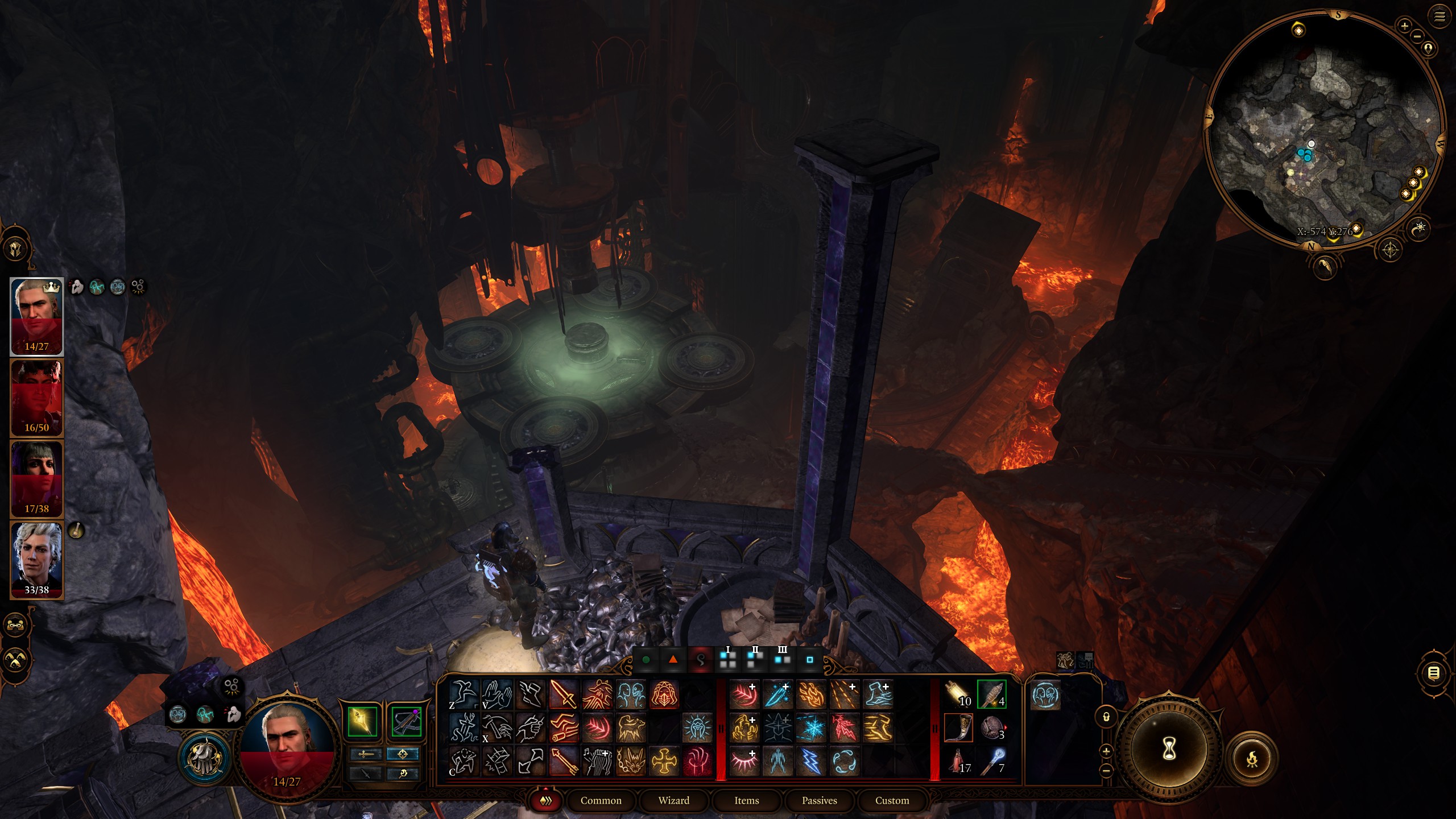
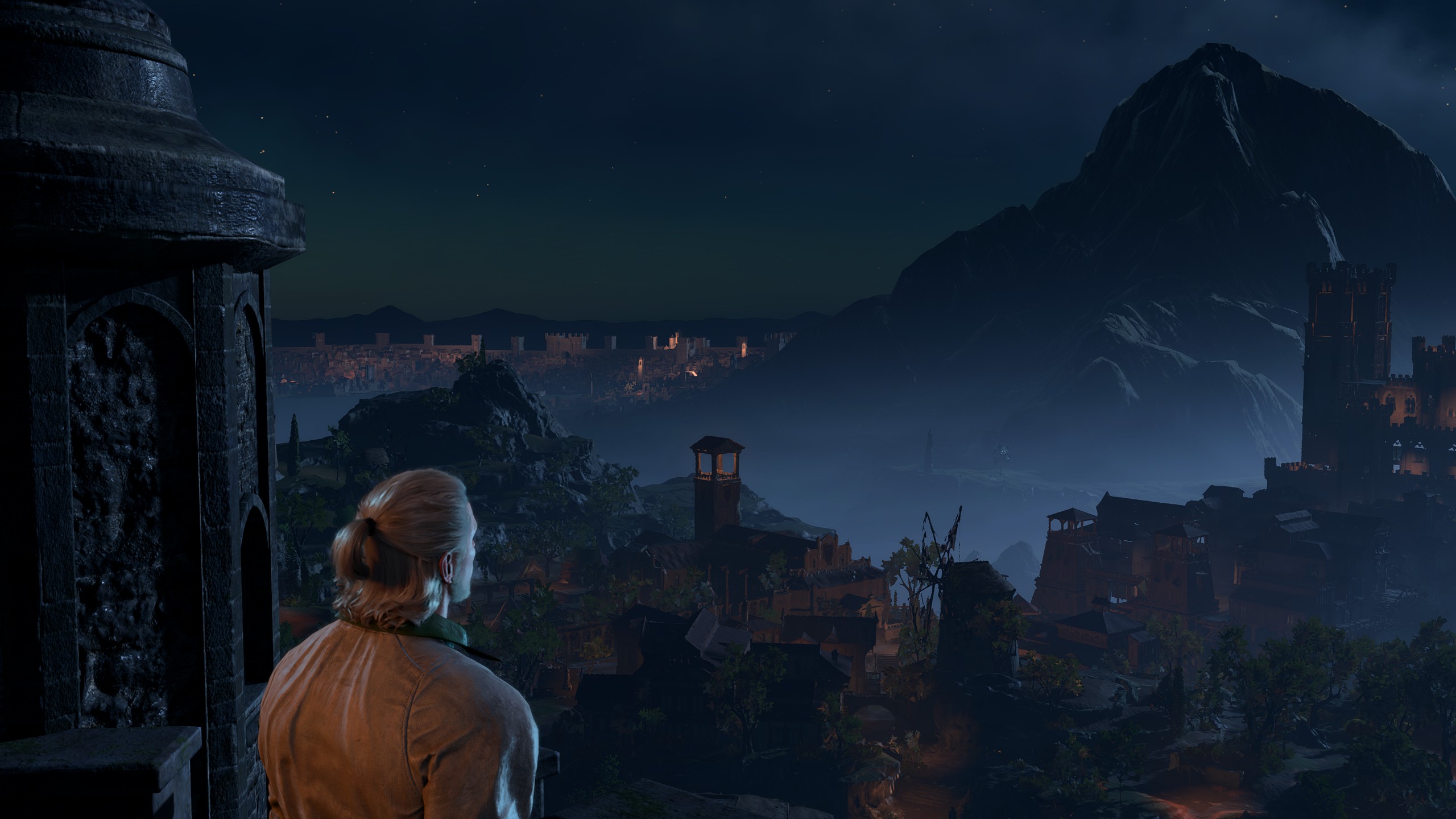
If the dialogue and character interactions are pretty enough, the backgrounds are the REAL diamond though. The top-down perspective lead to Larian using some really neat tricks and camera angles to display both close-up scenes and sprawling vistas. Huge views of the insane scale of the city of Baldur’s Gate, stunning drops into ancient temples to the Gods of Death, abandoned forges surrounded by boiling lava, wizards towers arching miles into the sky and then just serene and quiet views of lakes, villages and forests. Even gargantuan armies and a massive final battle across multiple dimensions. I went through the game and multiple times just had to pause to take everything in. It is a game of genuine beauty and also supreme care.
I think you can absolutely tell that everything was crafted with intent and passion here, Larian wanted to fucking deliver on BG3 and BOY did they fucking deliver. I think you can see the love for this game in every single nook and cranny of it. And lets be clear… There’s a LOT of nooks and crannies to explore (that’s what Shadowheart said anyway).
On top of this is the city of Baldur’s Gate itself. Cities in video games, particularly fantasy, generally seem to have a fairly high failure rate for immersion. From the very silly Whiterun with 20 people (biggest city in Skyrim my arse) and the “capital” city of Arx in Divinity 2 (consisting of two mansions, a shop, a burned embassy and a cathedral). It’s rare for me to get to a city and for it to FEEL like a sprawling metropolis. Novigrad in the Witcher 3 succeeds, and Baldur’s Gate in BG3 succeeds. Somehow it felt both massive and intricate, filled with exciting locations, without being SO big that it was inaccessible nor lacking with just ordinary houses and shops. I actually genuinely don’t think the devs got enough credit for this aspect, because of how challenging it seems to be to make a city feel like a CITY.

This is coupled with a genuinely fabulous soundtrack. It takes a lot for me to sit up and take notice of a soundtrack. Like, to the point that my favourite game of all time (Witcher 3) I still maintain has a slightly underwhelming soundtrack with very few “hummable” tunes (not bad to be clear, it just never “inspired”). Meanwhile the main score of BG3 is absolutely class, followed by the various perfectly emotive pieces of music for the different set-pieces. And, one has to make special mention of a tune which plays during one of the final encounters of the game where a game-long enemy literally sings the lyrics of the song while you fight him. I mean, again, PURE CINEMA.
This is actually one of the top compliments my friends had for BG3 as well. We’ve played a lot of games together, RPGs among them. None of them have had this sense of cinematic precision and spectacle which hooks you by the nose and draws you in with no chance to say “no, stop”.
For all my complaints earlier as well, mechanically the game is A LOT of fun. Combat did, admittedly, become a bit repetitive towards the end of the game. And the strange scaling of power meant that the Official Final Fight actually felt remarkably trivial. But at the same time, I went out of my way to find every single encounter and fight through them and enjoyed my entire experience. Playing as both a wizard solo and a bard as a group and I enjoyed both experiences. As a wizard just smashing haste on myself and then throwing around lightning fire and elemental summons without a care in the world, I DID feel like a legend by the end.

Meanwhile as a bard, I mentioned the lack of bard-specific spells, but it never did stop amusing me to use Vicious Mockery to call an Infernal Clockwork Automaton a “cuck” and then start playing music in the corner of the fight.
There’s also some absolutely fucking PEAK encounters in the game. Specifically, the Iron Throne Prison and the Grymforge are two of the most interesting, visually exciting, and enjoyable encounters of the game and display the DnD aspects of BG3 at its absolute best. But there are many others which were just-as fun for me.
There’s a huge amount of variety on display too, the game constantly felt like it was pulling out new and exciting things to explore and do. Plus, an overwhelming amount of branches and options. Of course, it’s a game, it has far more restrictions than actual DnD, but genuinely the amount of changes and effects which can accrue over a full run is staggering. There’s small tiny side quests round every corner and some of them end up having surprising results all the way at the end of the game. I consistently felt like I was having an impact on the story, characters and world around me, and in an RPG this is one of the single most important things you can feel.
As well as impactful gameplay, the game also featured a lot of just genuinely excellent moments. There were emotional and poignant moments (Karlach’s story in particular is a perfect example of this) but also just spectacularly hilarious moments (obtaining Volo’s Ersatz eye may well be one of the best things I’ve ever witnessed ever). And these were things which occurred both in singleplayer and multiplayer as well, with my friends admitting that the game contained some of the most memorable and cinematic moments in gaming, bar none.
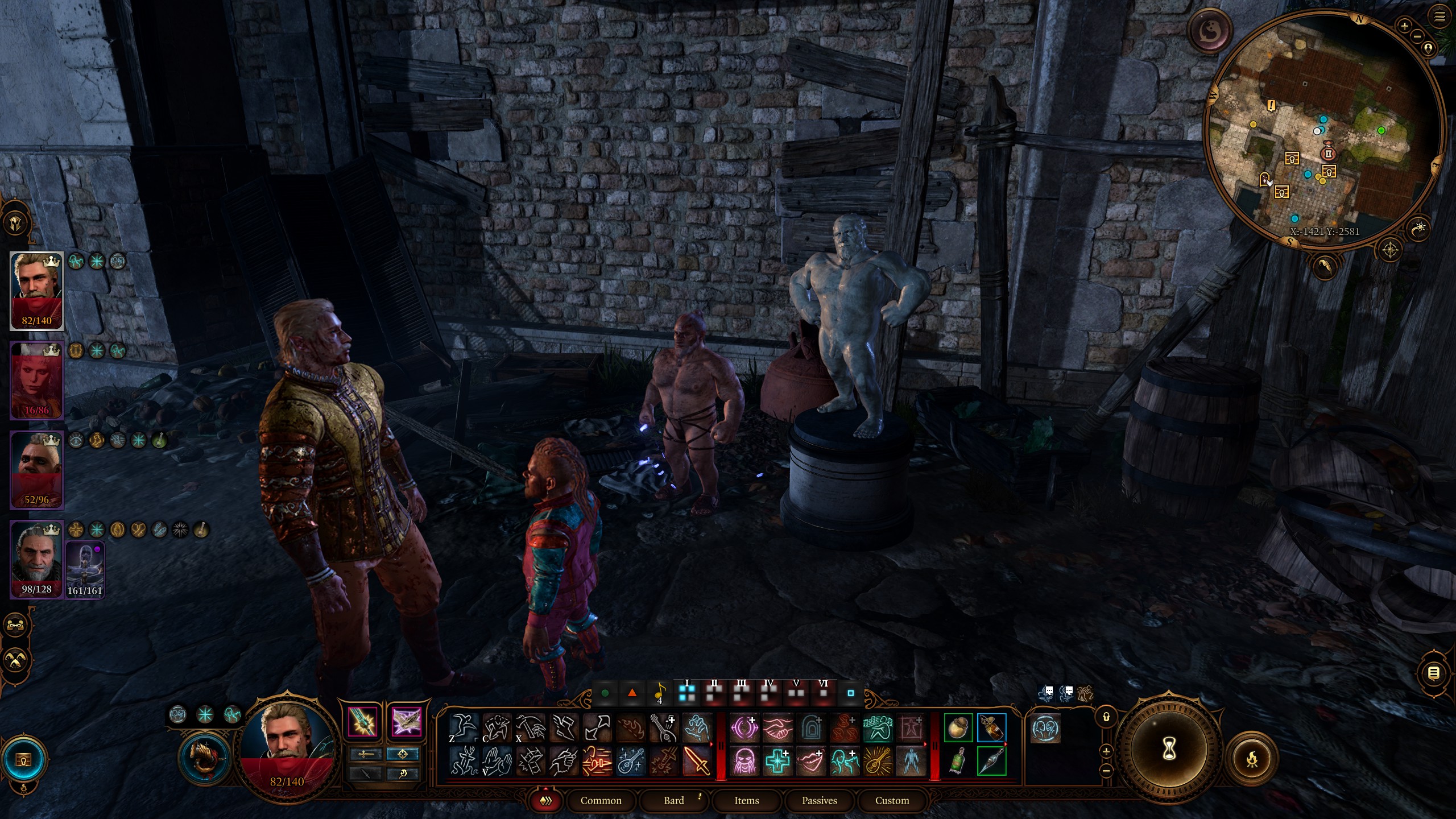
I’ll say it again though, playing BG3 solo is probably the best way to experience it, solely for the aspect of being able to interact with all the characters however you want. This extends to interacting with every random encounter in the streets, deciding how you will respond to requests to steal Githyanki eggs, rub warg shit on your face, or deal with deals offered by Devils. But really, an obvious highlight is the companions. Their changing relationships throughout the campaign makes them a constant delight to interact with and it must have been an absolute nightmare getting all the dialogue and stories to work properly given how intertwined everything is and in how many different orders things could be done. These are companions and friends that I put right up there with the top tier of Mass Effect games in terms of how invested I was in their respective story lines, although this is primarily directed at the “main” companions as opposed to the late-game ones.

Karlack, Shart, Astarion, Lae’zel and Wyll are all genuinely impeccable characters and they absolutely carry the game from “great” to “insane”. Which again, just makes it a shame if you miss 90% of their stories because it’s more or less vital that you have them with you at different points in the actual game world in order to progress their stories correctly. For example, in our multiplayer game, Shadowheart and Lae’zel got into a fight for reasons we had no understanding of, we took Shadowheart’s side and Lae’zel died… Only for her character to bug out and stay in our camp for the rest of the game. But then at an important plot point for Shadowheart’s character we couldn’t take her with us into the world, and so she got furious at us for leaving her out and so fucked off.
As a slight aside here, one thing which is slightly frustrating is that there are several points where it is almost VITAL that you have specific characters with you when you do certain quests. And while the game usually telegraphs this quite well, it does mean I felt compelled to check online a few times online to try and avoid missing anything important.
A final twist of a knife
Before I summarise my overall feelings I think I do want to touch on something I’ve alluded to a few times in this review and that’s Larian’s difficult 3rd act. Larian has, unfortunately, a bit of a habit of making games with intriguing and beguiling opening acts followed by absolutely stellar 2nd acts and then, for any host of different reasons, they always somehow blunder act 3.
Personally, I actually don’t think this is the case with BG3. I’ve seen a fair amount of hate for Act 3 online, but I genuinely think most of it is underserved. I think it’s an extremely strong act, it contains some of the best and most memorable moments of the campaign and serves as an excellent finale for the story…
HOWEVER, I won’t go so far as to say they knocked it out of the park.
For starters, the transition from Act 2 and Act 3 is absolutely dire. The finale of Act 2 felt like an absolutely sparkling conclusion to the first 60 hours of the game, tying a lot of threads together (whilst of course leaving the major battles still to come) and then it just absolutely flounders in shifting to Act 3.
I think there’s a few reasons for this. I feel like the final battle of Act 2 has the unfortunate side effect of killing all story momentum which means that effectively the game almost feels like it is starting from a NEW Act 1, instead of an Act 3. Whilst the overarching conflict remains unresolved, by this point you are only slightly familiar with the primary antagonists of the game and I think it would have helped matters a lot if these had been more of a focus in earlier stages of the story.
And lastly, act 3 is also the most sprawling of all the acts. Occurring in the city of Baldur’s Gate, it’s an absolutely MASSIVE act with quests around literally every corner, and when you are basically trying to build momentum from scratch and at the same time are given a thousand new quests all at once, it’s just overwhelming.
This is also them compounded by the introduction of several new companions including returning characters from BG2 and druid Halsin. Halsin was, somewhat infamously, a fan favourite during BG3’s early access and so Larian added him in as a permanent companion for Act 3. The addition of Halsin and the returning BG2 characters (who I assume exist for pure fan service) do make consistent sense within the game, but personally I think they also add a very difficult dynamic to your party camp. There’s now just slightly too many companions and having 3 with whom you will not get as close with as the others makes things just feel a bit bloated. I think keeping them in the camp might have been nice, give them their own quests, but making them fully fledged companions was, I think, a misstep.
There’s also lastly the issue of the Chosen Ones. While I do personally really enjoy every single one of the main companions, their personal quests, stories and romances, they do all suffer from one common issue: they’re all super, duper ultra special. Now, to be fair, this is meant to be a video game with earth-shattering consequences. So, there ARE big fights, encounters and decisions. But at the same time, in concluding some of your companion quests you will encounter SEVERAL straight up Gods or Legendary beings. Some of these do tie into the main story, but some do not, and that leads to a rather unfortunate situation where at the end of the game you go through 2 or even 3 encounters which each individually feel like a “world ending threat” but are just tangentially related to the main story!
This is… Cool… On an individual level. But it has the unfortunate effect of taking some of the weight out of the more major story beats because it feels like the whole final 20 hours of the game you’re basically solving multiple major crises one after the other. It just, again, somewhat stalls the momentum of the build to the conclusion of the game given how many Final threats you have to deal with before the FINAL FINAL threat. It makes me wish some of the companion stories were a tad more grounded and “personal” rather than every single one of them having to be The Most Special Chosen One.
Conclusion
I should probably re-emphasize that, yes I’ve whined a lot about overly self-important character arcs, mechanics which are tiresome and irksome and pointless (legitimately, what the fuck is the point of the “dipping” mechanic), a third act which is too bloated and sprawling (which also is amazing because of how sprawling it is) and a disappointment in never getting good enough loot.
In spite of all of this, Baldur’s Gate 3 honestly blew me away for all of the biggest reasons I play video games. Compelling story, amazing characters, gorgeous visuals, fun and challenging encounters and the opportunity to have “real” impact on a game’s world and story. It is about as close to a 10/10 as I think I can reasonably give games and has shot up to claim a number 5 spot on my list of all-time favourite video games (if you’re keeping score, the list currently goes Witcher 3, Mass Effect: Legendary Edition, Factorio, Bioshock and BG3, with Half Life 2 being bumped down two spots due to another recent release).
Rating: 98 Sharts/100
Verdict: Essential
| Pros | Cons |
| – Incredible writing, characters, story, and overall plot. This is the reason we’re here in an RPG and it knocks it out the park – Choices matter (or feel like they do) and can genuinely come back to haunt you, with small decisions made in early parts of the game affecting you all the way at the end – Stunning visuals from vistas to dialogue mocap and combat visuals – Thrilling emotionally. I won’t pretend I bawled my eyes out, but it had poignant and funny moments aplenty – Combat is solid and generally exciting, peppered with moments of pure excellence – Some of the best companions and moments in video games | – Third act of the game is bloated and kills a lot of the momentum from the previous two acts, resulting in a game which is absolutely peak for 60 hours, followed by 30 hours which can be a bit of a slog – Larian’s apparent decision to bend to fan pressure over certain characters leads to some weird inconsistencies and behaviour in the 3rd act where I just kinda wish they’d stayed true to the original vision – “This is not a new baseline for RPGs, this is an anomaly” |

 MMGaming.net