
You know, I remember exactly the moment where Disco Elysium successfully won me over. It was a few hours into the game at this point (I realise that this time-frame is potentially a bit of a red-flag, but lets brush past that) and I was in the process of trying to figure out who had killed the guy who was hanging from the tree in the back yard of the motel I was staying in (whilst simultaneously trying to deal with the complete amnesia about who I was and the world I was living in). There was a group of thugs hanging out in the lobby cafeteria of the hotel, thugs who were employed by the local union to “deal with trouble” and were pretty clearly ear-marked as basically the source of most of the local crime.
These guys straight up told me that they had lynched the guy because he had raped a lady who was staying in the upper floors of the hotel. Now… I DID know Disco Elysium was a clever narrative game, so I did assume there was more to this than met the eye, but I also figured this was going to be some kind of half-truth. A heroic lynching seemed a bit too good to be true but was probably most of the way there.
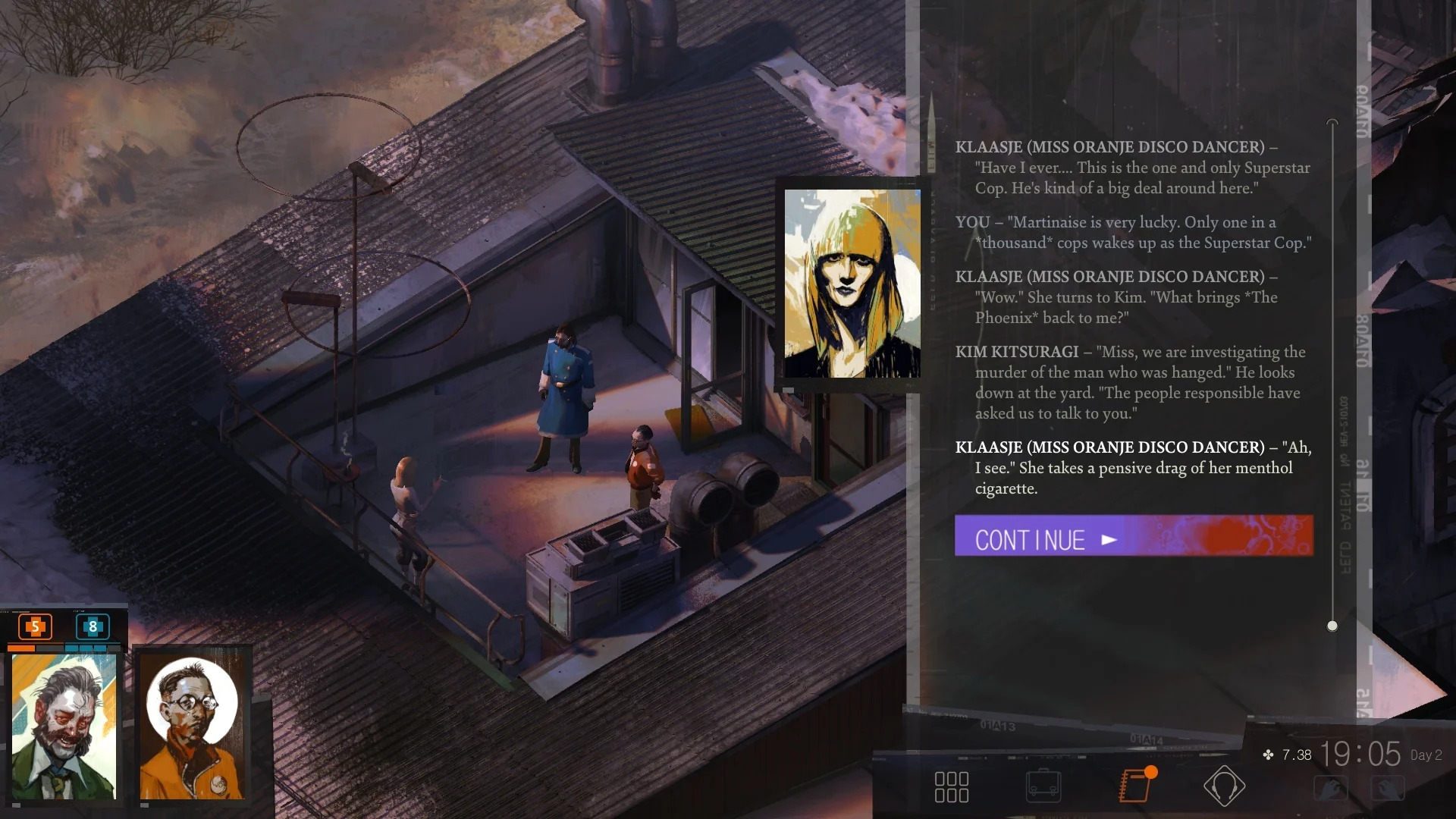
In what followed I went back and forth between the thugs and the victim no fewer than 6 times, up and down and up and down and up and down… In any other game I would’ve called this absolutely infuriating being forced to retread the same ground over and over again, instead of just having to interact with each character once and get what I needed. Instead I was made to gradually peel very tiny parts of the truth from each party, revealing more and more, catching inconsistencies and half-truths until a clear(er) picture of events finally emerged.
Like I say, in any other game, I think this would just cause eye-rolling and a sensation of having my time wasted. Here though, as well as revealing more about the mystery itself I was gradually revealing more about the different parties at play. The thugs weren’t just local muscle throwing their weight around, dealing drugs and drinking, and the woman wasn’t some damsel in distress used as a symbol to make the crime of murder seem more palatable. No, they were complex and convoluted people, each with their own agenda and desires.
And that’s the kicker right there. Not “characters” but “people”. I was hooked. Suddenly, this wasn’t some absolutely outrageous whodunnit where my amnesia was the main focus and I was the fated hero to solve everything. No, this was a literal living breathing world and I just happened to wake up in it.
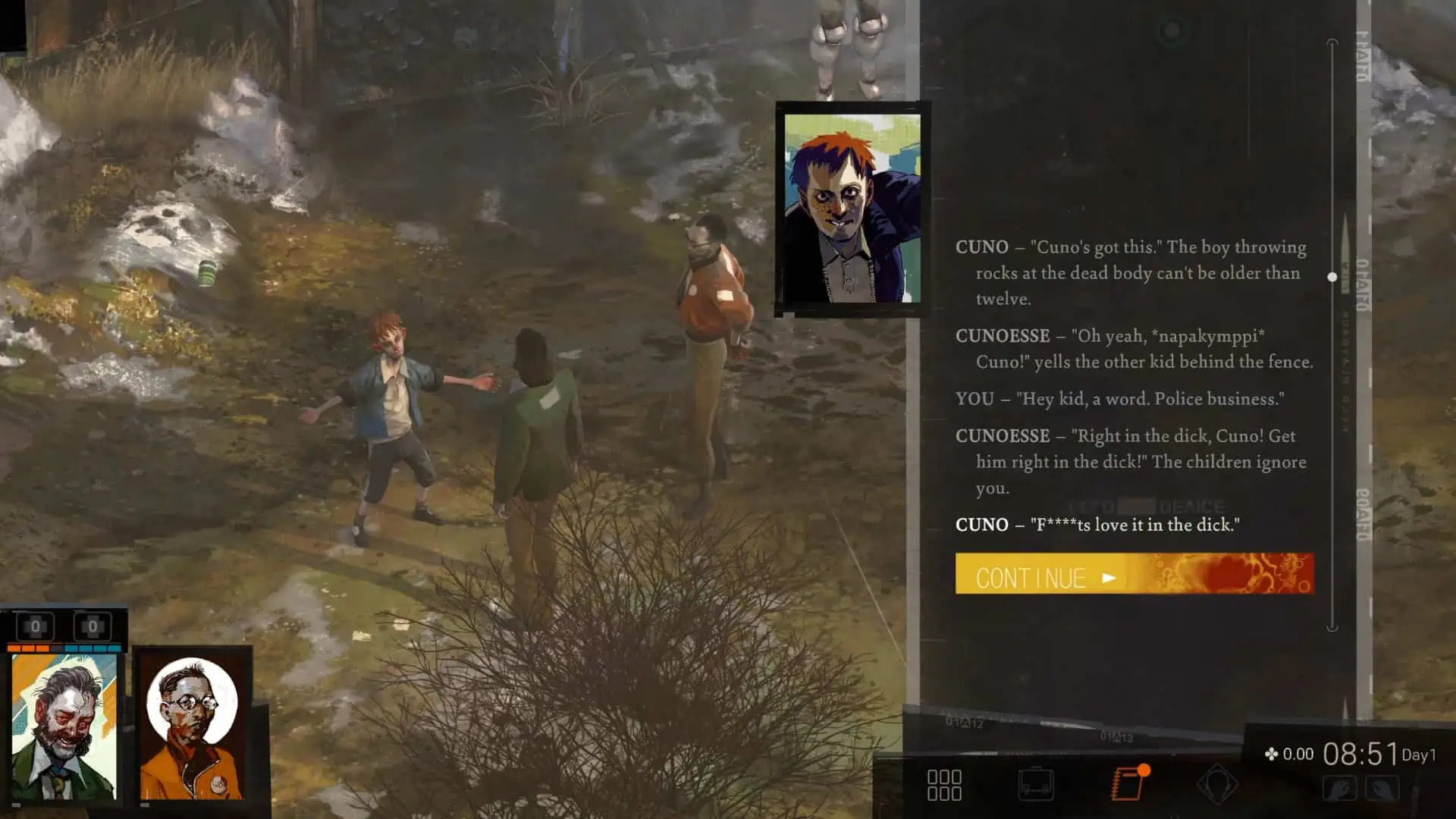
Now, I’ll admit, this is pretty lofty praise, so it also comes with some pretty big caveats which I need to get into (not least of which is that, honestly, in a lot of games I LIKE being the fated hero who will solve everything) but first, let’s take a step back.
Disco Elysium is an isometric RPG from ZA/UM from back in 2019 which still consistently finds itself in many top 10/20 games of all time lists. It is a FIENDISHLY cleverly written game where the writing itself is front and centre from almost the word go but it also is a game which is very much not for everyone.
I personally don’t like saying that, I think it’s an empty statement. NOTHING is for everyone, but I think it’s somewhat important to clarify that I think Disco Elysium for all the high praise around it is a game which is fucking obstinate and awkward and can be just really difficult to enjoy.
In Disco you take the role of a police detective investigating a murder. You also very quickly realise that you were both a massive alcoholic and drug addict and just prior to the events of the game you went on such a legendary bender you literally wiped every memory of the world from your memory. As such you are a complete blank canvas for the game to dump exposition on. You have to piece together who are you whilst simultaneously having to pretend enough at being a police officer to actually try and figure out the murder. This is a difficult enough task when you’ve lost your gun, your badge, your uniform and can’t even remember your own name.
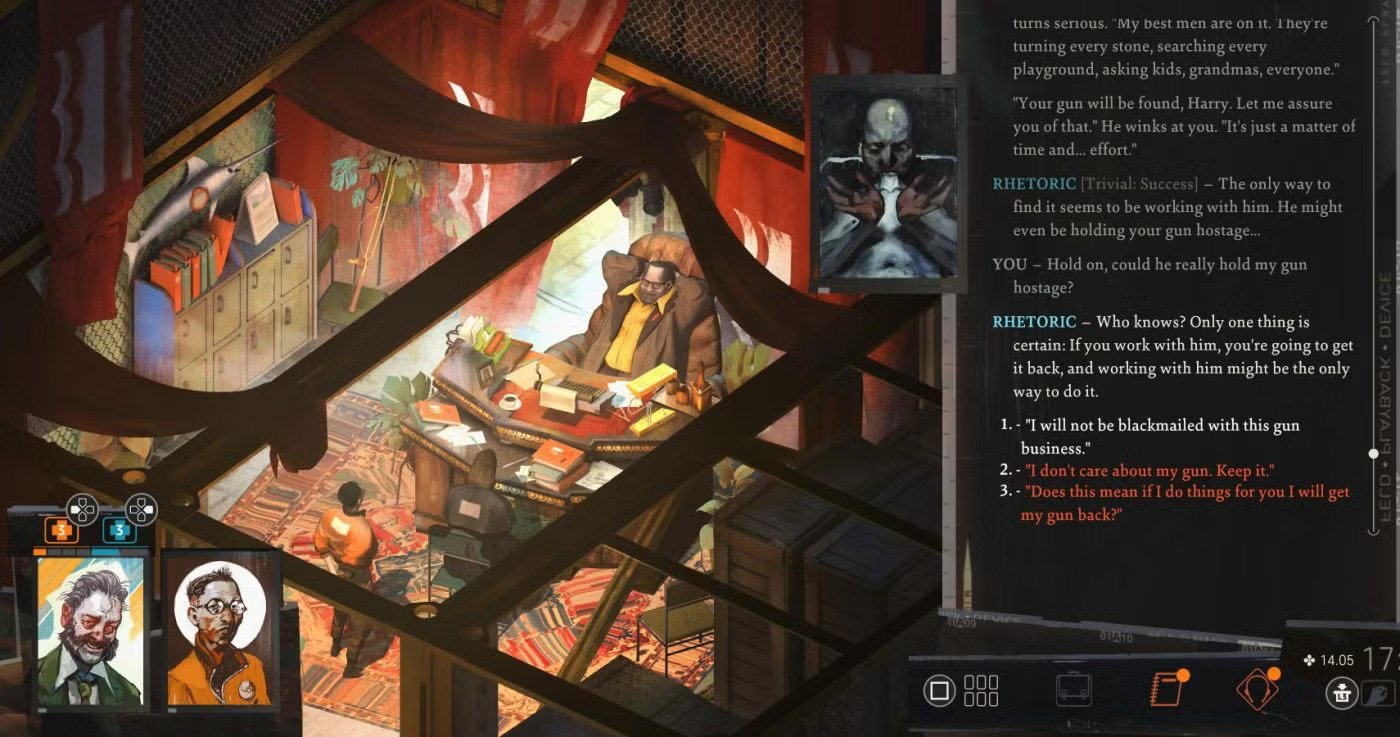
Now, while amnesia is a VERY common tool in the video game maker’s toolbook, everything else about Disco is just so bloody unique that it’s worth talking about. Its aesthetic is instantly recognisable from just about every angle: a particularly ARTFUL isometric view-point. It has uses a very weirdly impressionist art style to create the world, the characters and character art. Despite the genuinely unwieldy medium, it actually still succeeds at being a video game in the sense that the world is easy to navigate (mostly), menus are clear, characters are obvious, figuring out who and want you can interact with stands out. This alone I think is quite masterful given that the oblique medium feels like it wouldn’t lend itself to clarity.
I will say, I wish the map (when you get one) was more clear. At some point you literally even get a “cartoon” map of your surroundings, but fuck me man, it would’ve been nice to get a few more obvious street names and locales (and fast travel points).
Next is the world itself… Now I could go on for ages here, because honestly, Disco might be one of the most unique worlds I’ve ever experienced. Let me paint you a quick picture. Several centuries ago in the world of Disco, in the Occident (a group of nations who you could kind of loosely associate as being “olde time-y Europe”) a woman becomes the Innocence (this is sort of a super-pope of some sort, except they only happen once every “age” basically and it’s difficult to determine if this is a title they earn or whether its all political or even just history deciding they are one) who then leads the nations of the Occident across the “Pale” (basically a zone which was previously impassable, associated with the collapse of reality which I took to imagining being like entering another dimension where people cannot live). The Pale completely separates most places on the planet from each other and from this new ability to traverse it, they discover the Insulinde which is a gigantic archipelago (if you start imagining comparisons to the discovery of the New World, that’s what I did too). Now fast forward to only 40-50 years ago, there is a gigantic mega-city called Revachol which spans a significant portion of the Insulinde and it is ruled by a King, he is ousted by a Communist rebellion (once again, drawing parallels with the Bolshevik revolution in Russia) who proceed to fuck up the mega-city so badly that the Occident steps in and conquers the newly communist state and now sets up a whole new government there which they don’t actually rule but, in a very real sense they kinda do.
Now the city is a gigantic melting pot of many millions of people, spread across multiple districts and islands, not technically under the boot of the Coalition of Nations but not fully independent either. You are a cop in one district of the city and have to go to another district, an extremely poor run-down district which has sort of been ignored by government and police for decades and now is basically completely run by local worker’s unions-stroke-gangs.
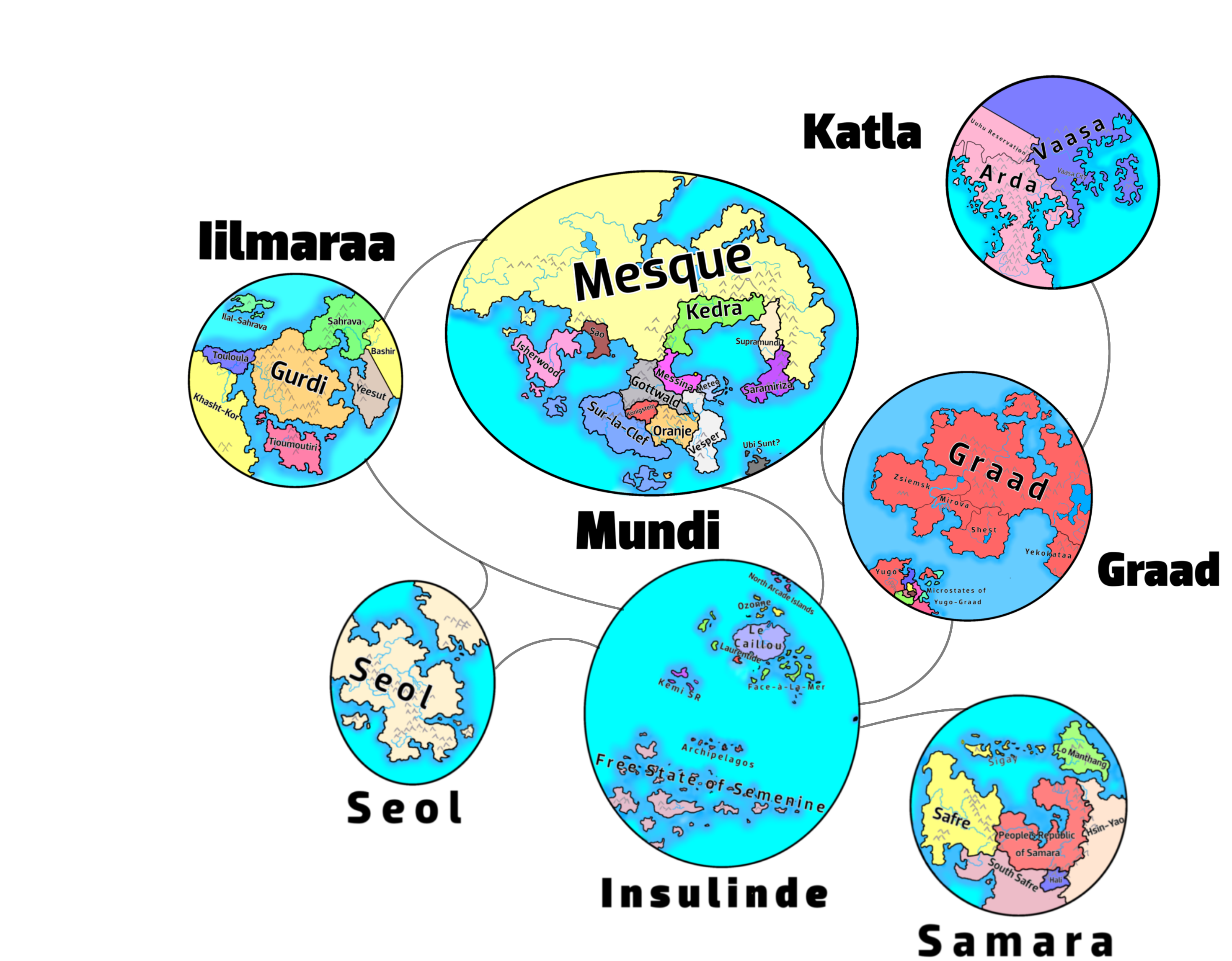
THIS is the backdrop of Disco.
If you think that any one of these ideas is enough to be the basis of a video game, then congratulations that’s exactly what I thought as well. You can’t just straight-up draw parallels from real life. They help of course, like the comparison of the discovery of the Americas, but that doesn’t tell the full story. The point being it’s such insane imagination on display that it blows my mind that this “Universe” is present in literally just this one game and nothing else.
An unfortunate side aspect of this and the aforementioned amnesia though is that when you explore the world and are trying to figure out just what’s going on, you can ask various people about the history of the world. Now, this can be pretty fascinating because you will get renditions which are coloured by the various political leanings of the person in question. The upper-class manager of a global corporation has a very moralistic view-point, certainly displays guilt for the fact that the coalition of nations basically rules Revachol, but isn’t exactly doing anything to change it. Meanwhile, the older guy who still wears his royal uniform proudly explains about how much better things were under the Surezain, even when it flies in face of all logic otherwise. Again, it’s all a living breathing world, and that’s super cool. What’s perhaps LESS cool is that in trying to help you understand all of this, as you will be getting all this via dialogue, you have to sit through fucking PAGES of people telling you about the history of a world which does not exist.
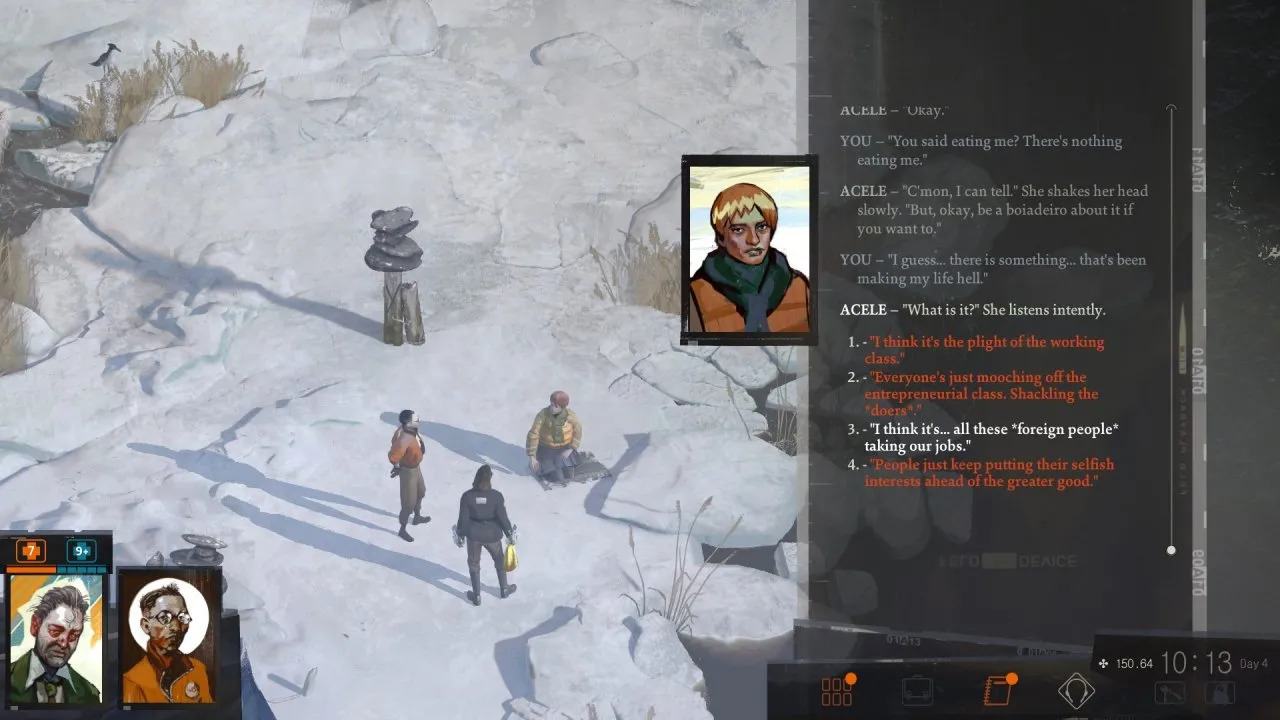
While you will never encounter all of it in any one play-through, Disco Elysium famously contains between 1-1.2 million words of dialogue… The entirety of the Lord of the Rings plus the Hobbit books contains less than 600k… Just for context.
Perhaps it is my fault for always wanting to exhaust dialogue trees, but the amount of exposition in the game is fucking insane and can become extremely tedious working through. Especially as it will often not tell you anything new, but it still feels important to investigate in case it somehow does
For the record as well, I tried to play Disco on its initial release back in 2019 prior to them adding any voice acting and let me tell you, all of this exposition was absolutely IMPOSSIBLE to deal with then. It was difficult WITH the voice acting, but just days and days of reading about wars between Libertarians and Communists? It’s too much…
As an additional note here, I really enjoyed the overall actual plot of Disco, but it has to be said that it also could potentially leave some feeling quite cold. Without wishing to spoil anything, which I will do at the end of this, the game’s overall plot and the way it wraps it up sort of leans away from classic Whodunnits in a way that feels much more “real”. And this is meant to be both a complimentary statement as well as a negative one.
I did absolutely love the sense of discovery that happened occasionally throughout Disco. Here and there finding a particular clue or putting together particular bits of information and watching yourself figure it out. I personally struggled to predict any individual element of the story, so having it all revealed to me as it was at the same time to your detective character, it was some of the best moments of the game. Weirdly though, some of the other best moments are things which are really just totally separate to the Whodunnit murder mystery. Remembering your own name, picking fights about politics and race, helping a bunch of drug-addled weirdos set up their own nightclub in a church with a strange magical effect on it. There’s some really cool stuff going on there.
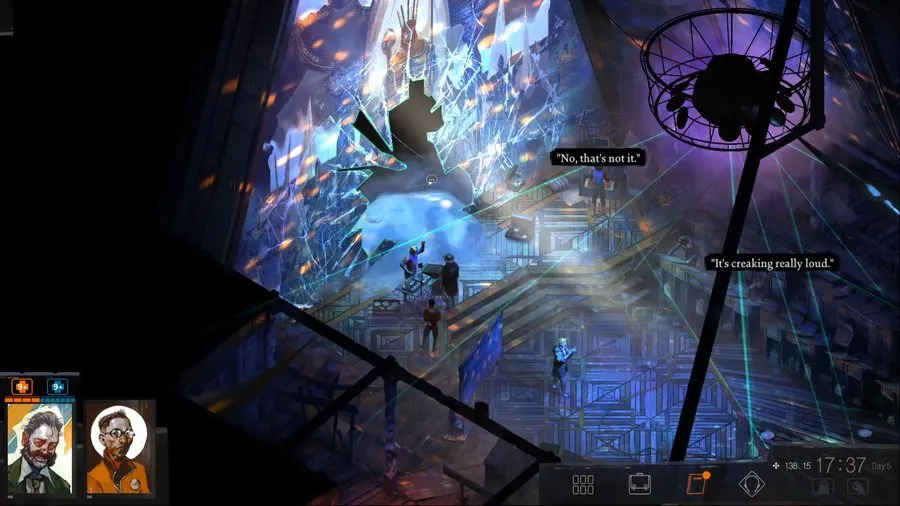
You can maybe see a bit of a trend here that a lot of the primary elements of Disco are a bit of a double-edged sword. Characters are written very believably like real people, which makes the world seem genuinely alive and ALSO makes interacting with them painful at times because so many of them have interests that do not align with yours. The world is insanely well-imagined and designed, but trying to learn about it in a 30-hour game is about as difficult as you can imagine being forced to learn about a whole new Universe’s political sphere and history in the same timeframe.
I think if this was all the game had going for it, it probably would not be as popular as it is, but there are further aspects which continue to elevate it. First is that while you CAN be like me and exhaust dialogue trees and ask everyone their political leanings. You can ALSO act like a complete hobo, substance-abusing, delusionally “famous superstar” cop. When people say something normal about how difficult their lives are in this district, you can then tell them that it’s all fine because the world is about to be swallowed by the void under the sun anyway and you’ll be doing molly whilst playing music to a legion of your fans when it happens. And then you get to see them get all weirded out and glance at each other and your partner, who just stands there sort of accepting that you’re saying weird shit again.
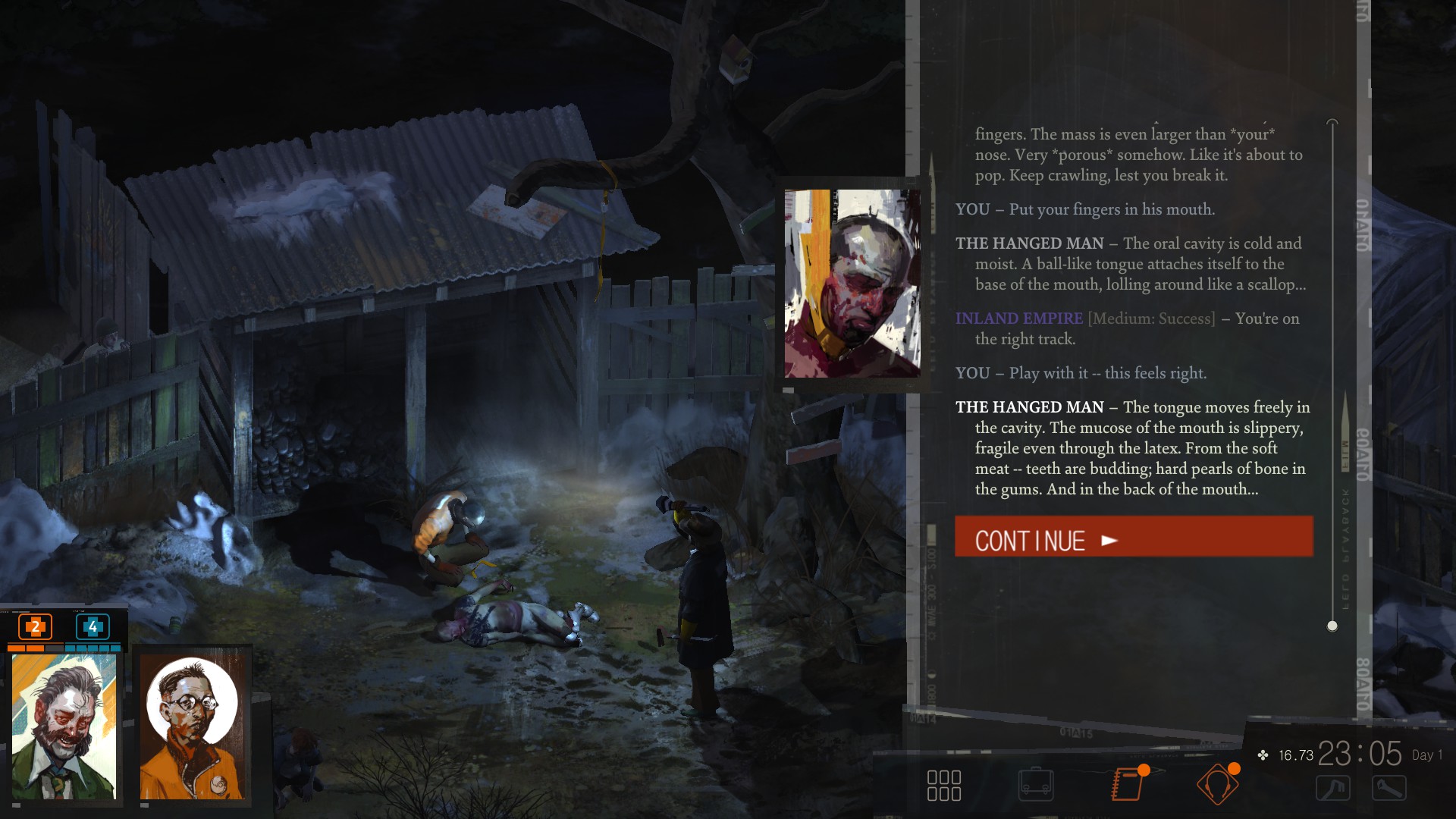
This stuff, when you lean into it, can be absolutely fucking hilarious.
As an aside, your partner, Kim Kitsuragi, is also a real big draw of the game. He is a bit of a trope in the sense of him being a by-the-book detective and a bit of a nerd. But he also is an absolute hard-ass, takes no shit, likes spinners and tuning up his cop car, and seems pretty relaxed about just letting you say your whacko shit without getting in your way. In short, he is an absolute legend. For someone who is the definition of a straight-edge cop, he also remains a pretty fun foil for your protagonists because he is also a realist and basically just accepts that you might go around doing tonnes of drugs and booze as just another part of the job.
The other constant companion of the game is actually your own psyche which takes the form of your own skills. Unlike standard RPG faire where you might have an intelligence and strength stat, here your stats are separated into things like Savoir Faire, Inland Empire and Conceptualisation. Aside from the two stats which govern your health and morale, every single other one of the “skills” is about as obtuse as they sound, but they also make up a vital part of the mechanics of the game. You will regularly get skill checks throughout the game, passively through dialogue and exploration but also active checks you have to willingly attempt, for all of these dozens of skills and you will only get a handful of skill points to distribute throughout the game so you can’t ever expect to become a powerhouse at everything. Ignoring the nomenclature, this is fairly standard RPG stuff here, where it becomes interesting is that every one of these aspects of your personality also then has its own “voice” in your internal dialogue and the more points you put into that trait, the more often it will speak up. In short, by putting points into specific traits it’s really much more about choosing your own personality than it is about min-maxxing skills.
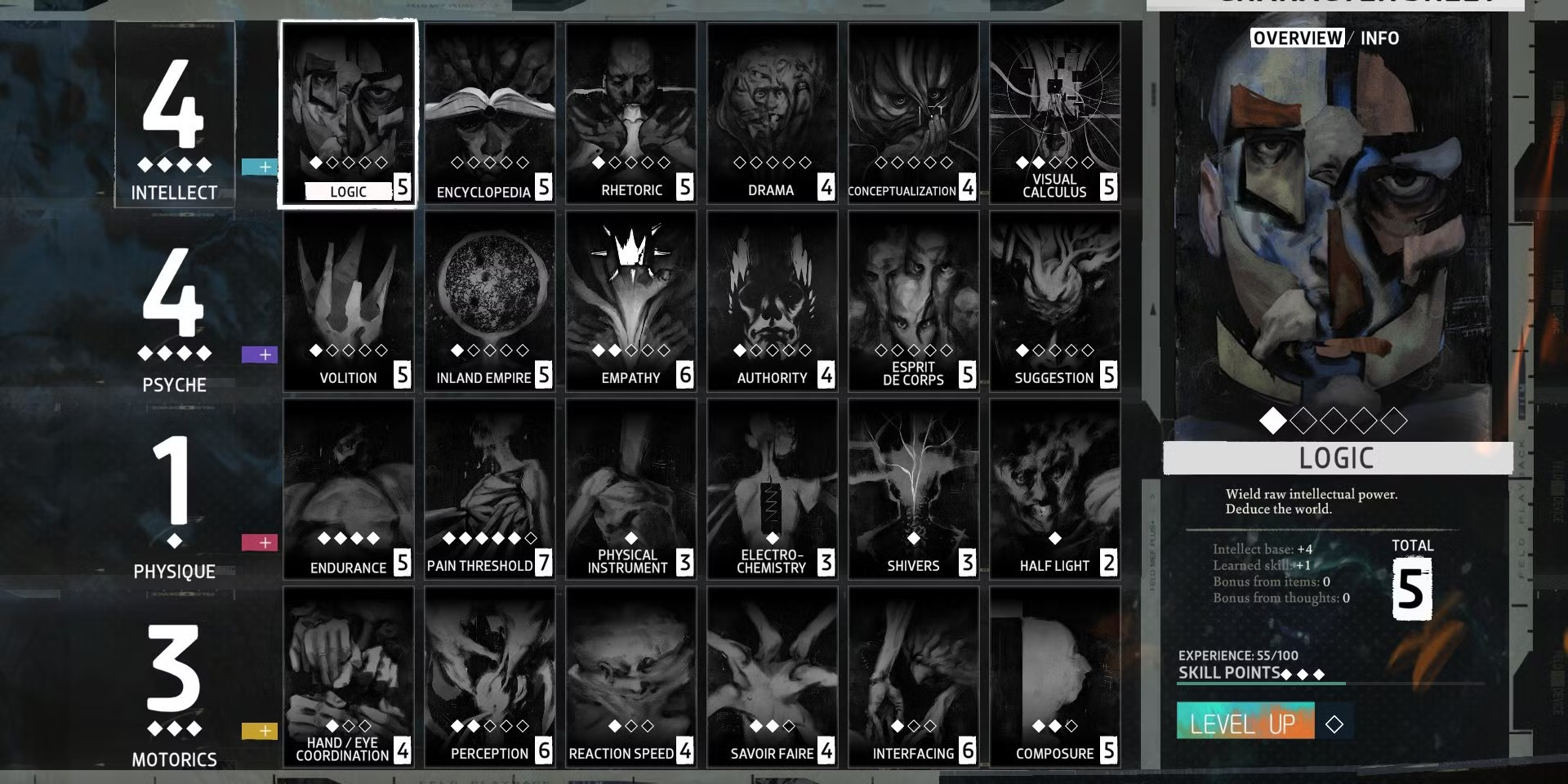
Having said that, this is also very much doable with dozens of different items of clothes in the game which give you boosts to different stats, and it can become a little bit silly and tedious to constantly keep switching between outfits for different conversations because for this skill check you need to be empathetic and the next one you need to be logical.
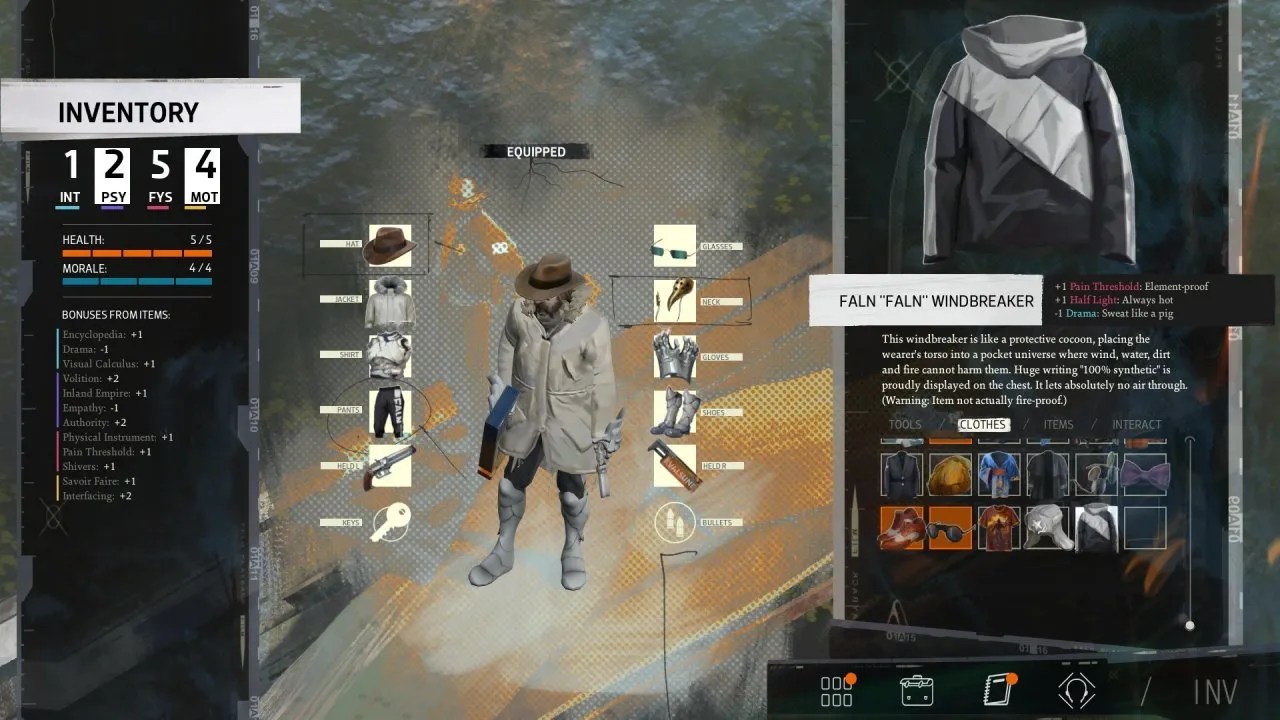
On top of that, the Thought system feels almost deliberately pointless. Thoughts are essentially perks which are obtained through triggering specific flags throughout the game, they then have the be “internalised” (allowing you to activate them) but you aren’t told what the outcome of the thought will be beforehand. And often, these thought as also actually pretty arbitrarily useless (for example one allows you to discuss sexuality with other characters). As such they also largely have to be treated as a roleplaying device more than for min-maxxing stats.
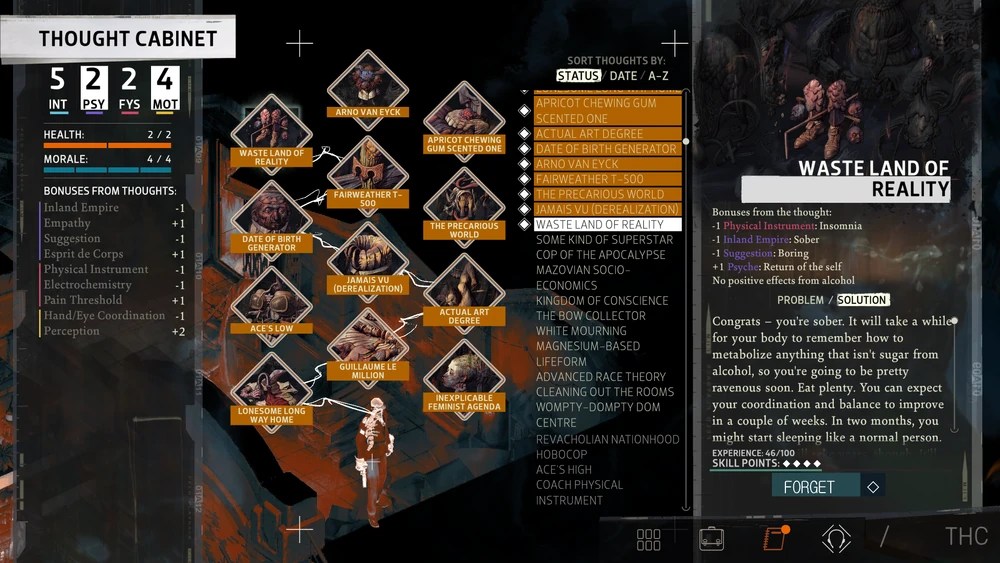
Personally, I was a big fan of the internal dialogue because it can be extremely amusing to listen to your internal monologue disagreeing with itself but also just going off on mad tangents about your sensations of the world around you. It really added a lot of colour to the game, and it also means that if you’re the sort to play the game multiple times, each experience might end up being really rather different. However, I found the thought system to be largely a bit frustrating because the gamer within me kept hoping for more “powerful” perks which just never really appeared.
An additional downside of the skill system is its effect on the voice acting. This was something that was actually one of the more hit-and-miss elements of the game for me. Jullian Champenois does a very solid job as Lieutenant Kitsuragi, and there are a few other standouts, but ALL of the internal monologue is performed by Lenval Brown. This is, by and large, fine (don’t let me give you the wrong idea about that) and he does a pretty commendable job putting on different personalities for the various versions of your internal monologue. However, he also had a habit of reading the lines just a bit too slowly for my taste which made me itch to skip through a lot of the internal monologues.
He also seemed to display a very odd habit of…
Emphasising and pausing sentences in…
Very strange places…
And this was also just quite jarring to deal with when listening to him constantly for 30 hours.
The only other aspect of Disco to discuss is the “gameplay” itself. This mostly consists of the aforementioned dialogue trees, but also a fairly big part is exploring the world, finding new information and then using that information to open new avenues of investigation elsewhere. Part of this also is related to the skill system where there are numerous skill checks you can retry across the map after levelling up and getting better gear for the related skill. For the most part this was amusing enough, but I will admit that I did get a little stuck occasionally about how exactly I was meant to be progressing, because a big part of the general feeling of Disco is “aimless wandering” and then stumbling onto some new answers or evidence. This has its moments, but that “aimless” feeling can persist for a fairly big chunk of the game.
I think it should be fairly clear by this point that I think the writing of Disco is absolutely incredible, the characters are absolutely iconic and the worldbuilding is second to none. Other parts of the game: the aesthetic, the gameplay, the voice-acting and mechanics all have their charms but also their downsides.
I want to come back to something I said earlier, that Disco is not for everyone. The way I see it is that if someone say The Witcher 3 is their favourite game of all time, I will nod and agree. Sure, it’s like when I say Lord of the Rings: Return of the King is my favourite movie of all time, it’s maybe a bit of a basic-bitch answer but there’s a good reason for it… They ARE the best godamn game and movie of all time. Meanwhile someone saying that Disco Elysium is their favourite game is sort of like saying your favourite movie is The Lighthouse. I’ll look thoughtful, I’ll nod and say something pensive like “oh, that’s really interesting, what a good pick” whilst I think you’re being a bit of a pretentious nerd.
What I’m saying is. Disco Elysium is ART. And I mean that in both the positive and negative sense of the word.
RATING: 81/100
VERDICT: RECOMMENDED
| Pros | Cons |
|
|
Thoughts on the ending
So, as I mentioned, I am now going to talk about the end of Disco Elysium and this is going INVOLVE SPOILERS.
SPOILERS FROM HERE ON, YOU HAVE BEEN WARNED.
So, essentially, at the end of Disco you do find the murderer, solving the mystery that you were sent to Martinaise to deal with. The murderer is someone you have not met throughout the story, you have no clues which would have led to him, there’s no clever solution or foreshadowing hidden and tucked away in dialogue in other parts of the game.
And why did he do it? The murderer did it for something as simple and twisted as a sort of ugly unrequited love. It has nothing to do with the massive political struggle you’re dealing with throughout the game. It doesn’t involve any of the major factions, the crime lords, the wealthy aristocrats, the bloodthirsty mercenaries. It is, essentially, a random act of violence by a random man for very little good reason.
Speaking to a friend about this, he hated it. He saw this for what it was: the whole game and its plot was pointless. All of that wrangling and trekking back and forth to try and balance the various sides and parties involved. All the different characters you meet, some with very real and good motivations to commit murder. None of it mattered. It was senseless and random and there’s no way of predicting who actually did the murder.
And for someone who loves Whodunnits and Crime Thrillers, he despised that. He felt like his time had been wasted.
Except here’s the thing. I suspect real detectives might also say the same thing that a lot of violence is senseless and without purpose. That it’s very, very rare for a story to be wrapped up neatly in a satisfying bow and most of the time, it’s just fucked up people doing horrible things to each other.
And that’s the story of Disco. It’s a REAL story. You’re not Columbo or Sherlock Holmes, solving cases, cracking wise and spanking Watson. A murder in a seedy part of town and a political upheaval at the nearby docks? It can just be a coincidence and just the way things are.
I will admit, that I saw this ending coming, so perhaps that’s why I don’t feel as bitter about it. I think I actually was tipped off when you find your best real option of the culprit and it becomes pretty clear that unless she’s amazing liar, Ruby is definitely not the murderer. This also happened just shortly after you find a dead body on a boardwalk, a dead body that is ALSO completely and 100% unrelated to everything else going on and as a police officer you just have to call it in and move on.
But there’s the other side as well. The unexpected light moments of Disco. Having a dance with Kim, singing some karaoke, and finding the Insulundian Phasmid. It’s so clearly earmarked as being a bunch of whackos hunting for bigfoot, people that Harry is humouring because he’s just a bit whacko himself, so when you suddenly discover the mythological creature right at the end, this feels like the biggest moment of the game to me.
Maybe that’s the message, appreciate the small and crazy moments of life when they appear because in the end, nothing really matters?
How nihlistic… I’d quite like to shoot some aliens now.


