
I’m fairly late to this particular train (understatement of the year), but man, Obsidian Entertainment make some absolutely shit-hot narrative games. KOTOR2, Fallout New Vegas, Pillars of Eternity and Tyranny. These are games where the story is front and centre and because of it they’ve remained beloved games for decades after release (with many still insisting New Vegas is the absolute pinnacle of the Fallout genre).
After playing Pentiment from last year I think I have to say, maybe it’s about time I actually gave those others a fair shake (the fact I haven’t finished KOTOR2 and FO:NV in particular are massive dents in my story-loving nerd cred). Pentiment is itself quite simply narrative gold, it’s an exceptionally well-written and well-delivered story from beginning until the end. It even makes me want to retry the Outer Worlds (which I bounced off harder than your mum bounces off diets).
Pentiment is also one of those games though where I feel like the rating I’ll provide at the end may not do it justice because while I’m certainly going to rate it highly, I also think that Pentiment absolutely is not for everyone (and generally I feel like a high rating also should come with broad appeal).
In fact, I feel like the game somewhat leans into “not being for everyone” with the obscurity of its setting and uniqueness of its aesthetic. The game is set in the early 1500s in Bavaria where you take up the role of journeyman artist Andreas Mahler who is busy working on his masterpiece in the scriptorium of the fictional Kiersau Abbey (and yes, I did have to double check that place didn’t really exist). The game is also presented in a very unique style, with the design of the characters being very reminiscent of things like the Bayeaux Tapestry or Reformation-style art, animated to be almost like cut out paper puppets on a painted background. Obviously you may need a moment to collect yourself and calm down after hearing quite how high octane that particular set-up is…

It all combines to being one of the most absolutely striking examples of unique design I’ve ever seen in video games, but also practically screams at the top of its lungs “if you’re hoping for explosions, damsels in distress and saving the world, you’re in the wrong place son!”
Early on in the game a member of the nobility, Baron Rothvogel arrives at Kiersau and after stirring up a bit of a hornet’s nest with his presence is found dead the next day. The person suspected of the murder is Brother Pierro, one of Andreas’ friends, and so Andreas sets out to find evidence which would exonerate Pierro.
The first act consists of the investigation conducted by Andreas into this murder, concluding with you presenting whatever evidence you found and simultaneously deciding who you believe the real murderer was. The second act follows a relatively similar path of another murder in Kiersau, now under the looming threat of the 1524 Peasants’ Revolt and the villagers of Kiersau attempting to gain some kind of human rights, and again concludes with a far more dramatic situation of Andreas presenting evidence to save another innocent accused (if I’m being vague here it is because I’m trying to keep things as spoiler free as possible).

Both of these murders occur with undercurrents of some additional conspiracy or underhanded machinations going on behind the scenes, making it clear that maybe all is not as it seems. It is only then in act 3, after a full 20 years time-skip that all of this concludes at the hands of a new, secondary protagonist.
I summarise all of this because I feel like there are a few aspects of the story which one needs to be aware of and which directly affect my rating.
Let’s start with one of the biggest negatives, for me. As you investigate each murder you are given a limited amount of time slots across only a few days in which to gather as much evidence as possible. In each case you will have several possible suspects and potential sources of clues and so you have to run back and forth across the town to poke your nose into as many of them as possible. All with the knowledge that you will, literally, not have enough time to investigate everything. And this is made even worse by the fact that there will often be other additional activities you could take part in which occupy timeslots but do not necessarily forward the investigation.

This is, honestly, extremely frustrating both from a gameplay and narrative perspective. From a mechanical perspective it means that seeing everything (or at least a version of everything) necessitates multiple playthroughs, which is something that I am not a fan of being forced to do (even if I do understand how it provides replay value). Then, from a narrative perspective it makes the investigations themselves feel a bit unsatisfying, because it feels like you weren’t able to uncover everything you needed.
When it comes to making your accusation it doesn’t feel like you are revealing the truth, but rather instead you will make your accusation most likely based on whoever you investigated the most. There’s no Sherlock Holmesian moment of realisation, and so it means that when you reveal who you think you think is the murderer the game just looks at you and goes “oh really? Interesting…” And leaves it at that!
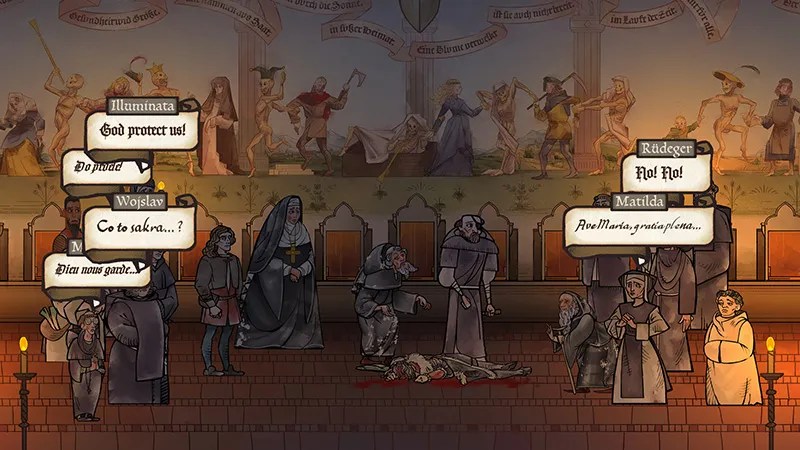
I think the core issue here is that the game isn’t necessarily trying to be a murder mystery game (as much as it might superficially seem like one). It feels far more like the emphasis is on the characters, the village and the interactions and drama between everyone. The issue is that this makes the decisions of who the murderer feels almost like it doesn’t matter (something which I even wonder whether it is an intentional theme of the game). So, the fact that the actual “whodunnit” part of the whodunnit game is a bit unsatisfying is a heck of a blow, made clearer by the fact that you can never collect all the evidence and at least make your mind up about who the REAL best culprit is.
Another, smaller, potential issue I had with the game was the change to the secondary protagonist (who I will avoid naming again to avoid spoilers). This is purely from a investment perspective where I tend to dislike last-minute switches in player-character, because it often feels like it is no-longer “my” character and instead some temporary face I now have to control for the game. I also went into chapter 3 feeling like a lot of the set-ups from the previous chapters had not been properly dealt with or concluded.
I will say that at least with this issue, I wasn’t giving the game or the writers enough credit. You too may experience confusion and disappointment at the switch, for similar reasons, but allow me to reassure you that actually the game still succeeds in tying everything up in an extremely satisfying way and that my initial disappointment at the switch in protagonists has now been replaced with absolute approval.

Once more, I really do wish that there might have been more capacity for Andreas to guess what was going on with the behind-the-scenes conspiracy. It does make sense narratively that he couldn’t but it still just stuck with me a little that this big mystery game doesn’t really feel like it allows YOU to solve the mystery.
This actually leads into one more major niggle and that is the ever-important illusion of choice. It personally felt like I had a lot of impact in the way each set-piece in the game played out, with a great deal of variety in conversation as well. But the way the game approaches the overall conspiracy means that inevitably the actual impact of your decisions is definitely very, very minor. The only difference it makes is whether this character is wearing a hat the next time you see them, 20 years from now.
Now, enough with the whinging, lets get onto the praising… God… Amen.
First and foremost, I said that the game seems to focus on character and interactions with others and that absolutely is true. Admittedly many of the NPCs, particularly the women and the nuns actually (who all wear similar dresses and cover their hair), sort of blend together, but outside of that there are still dozens of interesting characters to speak to. Characters that you absolutely feel compelled to visit and revisit to chat to as many times as you can.
This ties back into an aspect I mentioned earlier of Andreas being able to spend time in a few locations which do not actively advance any investigation threads. This includes something like sitting in on the village women’s knitting circle just to get the latest hot goss about who snogged who at last year’s village fete. And I am fucking here for it! This kind of character building is absolute gold and did wonders for making me invested in the lives of these villagers and monks, even if it did unfortunately bugger me out of being able to complete one of the investigation threads…

The game’s system of persuasion checks is also very subtle and excellent, with persuasion points being allocated based on everything from the larger, important decisions one can make throughout the game to even small, key decisions made throughout the dialogue leading up to the persuasion attempt. Andreas also gets to pick a few character traits (such as where he went to University, what he has done on his Wanderjahre and broader things like “bookworm” or “hedonist”) which also allow him to occasionally spice up his dialogue and choices with a few fun tidbits. Such as being an absolutely massive flirt at every opportunity, which was rather amusing.
This means that every single dialogue feels simultaneously important, but also, it’s not quite so edge of your seat that its stressful. Essentially, interacting with all the various NPCs and learning about them and their lives is absolutely fabulous. Made all the more compelling by just how bloody authentic the game is.

The art-style of the game takes a tiny bit of getting used to as it can actually feel even a little low-fidelity, but eventually the sheer authenticity of feeling like you are IN a medieval painting just won me over. It’s a gorgeous game and is lovely to run around, with some absolutely cracking sound design. It also repeatedly smacks you over the head with the evidence of exactly how much research must have gone into making the game feel as much as possible like you are genuinely in the 16th century Holy Roman Empire. This is a game where effort was made to deliver an experience which almost feels akin to ready a history textbook at the same time as a murder mystery, and I absolutely love it. Of course, one could reasonably make the point about them showing off, that they’re being just a tiny bit hoighty-toighty with their artsy-fartsy tapestry and history lessons, but I am here for it! Tell me more about the politics of the free cities, the Swabian League and the HRE please!
Even the way the dialogue and story is delivered has that same feeling of consideration behind it. where each character speaks as if someone is hand-writing their dialogue for you (complete with spelling errors and mistakes being corrected as it goes along). Even more than this, the style of a character’s speech “writing” changes based on Andreas’ perceived evaluation of the individual’s educational level, with people who he discovers to be printers changing from a peasants scrawl to typeset, and others switching to the neat lettering of aristocracy. It’s just an incredible attention to detail (although admittedly was occasionally a tiiiiiiny bit too slow for me and my reading speed).
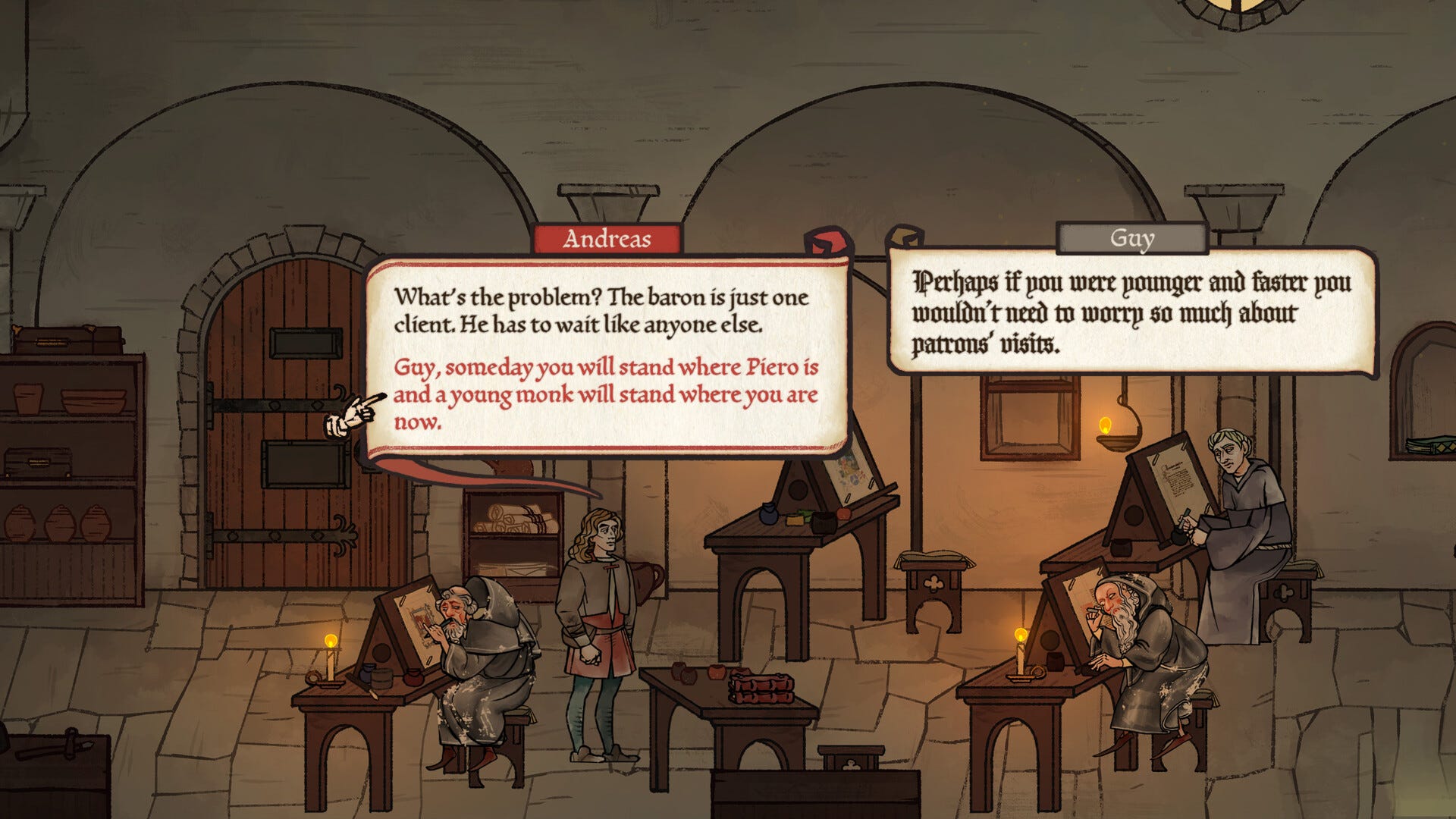
This same authenticity also then means that the influence you have over the characters and their lives feels constantly important. There are no big or earth-shattering stakes here. You won’t be meeting Martin Luther or helping to crush the peasants for the nobility, all the decisions you make are small-time for a small town. But this actually almost elevates the game for me, giving it weight and keeping it extraordinarily grounded. Andreas may even have been moderately important for the time, given that he is one of the very few people of the age who could travel and was educated, but he still feels like just another piece of forgotten history in the lives of a village 500 years ago. It’s wonderful.
That actually somewhat ties back into what I said earlier about the theme of the game, where I almost feel like one of the bigger themes of Pentiment is about human significance AND insignificance. How it is important to make connections and value the people around you, because in 20 years’ time a place you once knew will become unrecognisable, so forget about how much influence you could have in 100 or 500 years and instead focus on making the best decisions in the here and now. If you feel like this message could be both ultra bleak or kind of lovely, you’re not alone, the game did genuinely inspire a very brief existential crisis for me.
Coming back to reality I would say one of the few other minor complaints I have about the game is the way that it displays additional knowledge for you. During conversation, certain words or phrases can be highlighted, meaning they are linked to the in-game glossary (which includes all named characters but also then bits and pieces of historical information and knowledge). Clicking on these however is something which was never really felt that nice and more than once I accidentally clicked through to the next piece of dialogue. It’s a very minor gripe, but did happen often enough for me to remember it.
I will stand by my evaluation that the story and characters of Pentiment absolutely elevate it and carry it to success and so if these are the things which you value in your games then I cannot recommend it enough. The fabulously unique setting and design also just utterly solidify the game in my memory, making it an extremely enjoyable and memorable experience. In the end though, I will say that I still feel like the murder-mystery aspect of the game, which seems to be the game’s primary “mechanical” aspect really is a bit lacklustre and never allows for that clever feeling of having solved the mystery.
RATING: 82/100
VERDICT: RECOMMENDED
| Pros | Cons |
| – Simply utterly fabulous writing. Full stop. – Characters are just ordinary, everyday people and that just makes them totally compelling. – One of the most unique aesthetics and approaches to game design I have seen in a long time, which absolutely makes the game stand out in the mind. – Approach to diplomacy and speech checks is weighty and measured whilst also not making you constantly second-guess every decision. – Lovely, cozy vibes of just chilling with your villager friends in the 1500s, despite the backdrop. | – Murder mystery game where the actual solving of the murder mystery seems to take a back-seat. It’s not necessarily a negative, but it is a letdown based on the initial impressions – Overall illusion of choice is relatively low. It certainly feels like there’s plenty of choice in dialogue, but due to the aforementioned issues with “solving” the mystery, each playthrough is still going to more-or-less follow the same route. – Shut up about the passage of time! Shut up about the passage of time! |
Let’s talk politics
I have a few times in the past dedicated a separate section of a review to discuss political aspects of a game. I’ve mentioned before as well that I believe political message and leaning should be discussed separately to “whether a game is good” which also means that oftentimes when I DO discuss politics it is because a game has been extremely heavy-handed with its message and ruined potential enjoyment of the game by instead choosing to soapbox at me.
I think I am far from the worst person to get irritated by these things and these days am even relatively tolerant of it, compared to the worst of the Frogs from online. But it is still something which crops up occasionally.
So, to be absolutely blunt, I wasn’t even going to include this section had it not been for the fact that I saw numerous Steam reviews and threads asking the question: “is Pentiment woke?”
Let’s, for now, ignore any meta-debate about what constitutes “wokeness” and instead focus on what the question is really asking. Does the game shoehorn modern political sensibilities (particularly hard left-wing ones) into its story and setting and in doing-so, does it actually ruin the experience and narrative?
There are three things I can come up with that might explain why this question exists.
Thing one. The game absolutely makes mention of both the historical mistreatment of Jews and of women. Women are mentioned as having little control over their lives compared to men, meanwhile it is at least once mentioned how Jews are persecuted across neighbouring cities. This is in a time period where women were had absolutely no political power and were primarily housewives and mothers and Jews literally underwent pogroms many, MANY times. The game ALSO does NOT beat you around the head with these facts. It mentions them both in passing, by characters for whom it absolutely would effect and you would expect to know about these things, and then it moves on. Along the lines of: “Hey, us Jews are persecuted in this city!” and then you can say: “Oh, no that sucks.” In fact, if memory serves, Andreas even has the option of saying something along the lines of “Serves you right for being Jewish and not Christian then!”
So: if mentioning historical facts and presenting them largely in a sympathetic light is “woke”. I guess so? Personally, I felt it was always a light touch and always absolutely made sense in context. So, no wokeness here.
Thing two. Forced representation and tokenism. In a period where very few people travelled and you have to find historians who will bend over backwards on themselves to come up with reasons why there could be individuals with dark skin in 16th century Bohemia, it might be surprising to find two individuals of darker skin in Pentiment. It MIGHT be, but again, the presence of both individuals actually makes perfect sense within the context of the game. Neither are major characters and simply add a bit of extra colour to the tapestry (pun intended). It might be a little UNUSUAL, but it certainly doesn’t stretch the suspension of disbelief. Particularly given that this is closer to the South of Europe and in heavy pilgrimage territory.
So, no, I also do not believe that this particular argument holds much weight. Even if you feel like it does break suspension of disbelief, the presence of both characters is so minor and unintrusive I really have to question your motives if you think that constitutes wokeness and forcing an agenda.
Thing three. Sister Illuminata’s speech about women…

Okay… Yeah, if anything is the real culprit behind Pentiment’s supposed “wokeness” it HAS to be this one. Because this is the ONE, single, solitary bit where I felt like the game slipped and it was starting to push an agenda.
Essentially, a nun (Sister Illuminata), very early on in the game has a bit of a go at Andreas for one reason or another. In this speech she insists that different classes have their place in the hierarchy of the world (I.e. peasants, nobles, the Pope, God, that kind of thing). This feels very much in-keeping with the times, particularly for a nun. She THEN goes on a tirade about how little control women have over their lives, how oppressed they are and essentially how they deserve the same as men… Absolutely brushing past the fact that she basically had just insisted that peasants were meant to stay peasants. Not if they’re women apparently? Women alone deserved better?
Honestly, this whole speech was so out of place with the rest of the game that I feel safe in providing my overall judgement now: NO, Pentiment is NOT “woke”. It makes passing mention of a few lefty-leaning topics, but really, that’s about it.
This one particular example is an outlier, and honestly a confusing one at that. If anything it almost seems to make Sister Illuminata seem like an absolute hypocrite more than whatever else (instead of like suggesting she’s a forward thinker or anything like that). It also felt so much like soapboxing, in a game which genuinely does not do it anywhere else, that I am completely baffled by its inclusion.
Given that it happens pretty early on, I can actually understand people running from the game, assuming that the rest might be just more of the same. However, I do urge you to take on board the fact that is genuinely IS the only time the game does it and is such a minor occurrence it can really just be ignored as a bit of a women moment.

 MMGaming.net