
I have in the last couple of months played a couple of new “point-and-click” (I use the phrase loosely) narrative-focused games which both use time elements and resource management to drive their central story. The games in question here being The Pale Beyond and Citizen Sleeper. The similarity of the mechanics of both games combined with the fact that I played them sort of back-to-back made me think it might be quite fun to just do a combined review of both of them, comparing and contrasting as we go along.
Overview
In The Pale Beyond, you are the ostensible (foreshadowing, foreshadowing) second-in-command of an expedition to the uncharted Antarctic regions of the planet, in a sort of early 20th century, British Empire spirit of derring-do sort of thing. The game could basically have been called Shackleton: The Game and you’re 99% of the way there in terms of setting. The aim of the expedition is actually to try and rescue the crew of a previous expedition sent out to explore the region, although from the start there’s a lot of side-eyeing going on, suggesting that there are other motives and machinations behind the scenes at play (FORESHADOWING, FORESHADOWING).
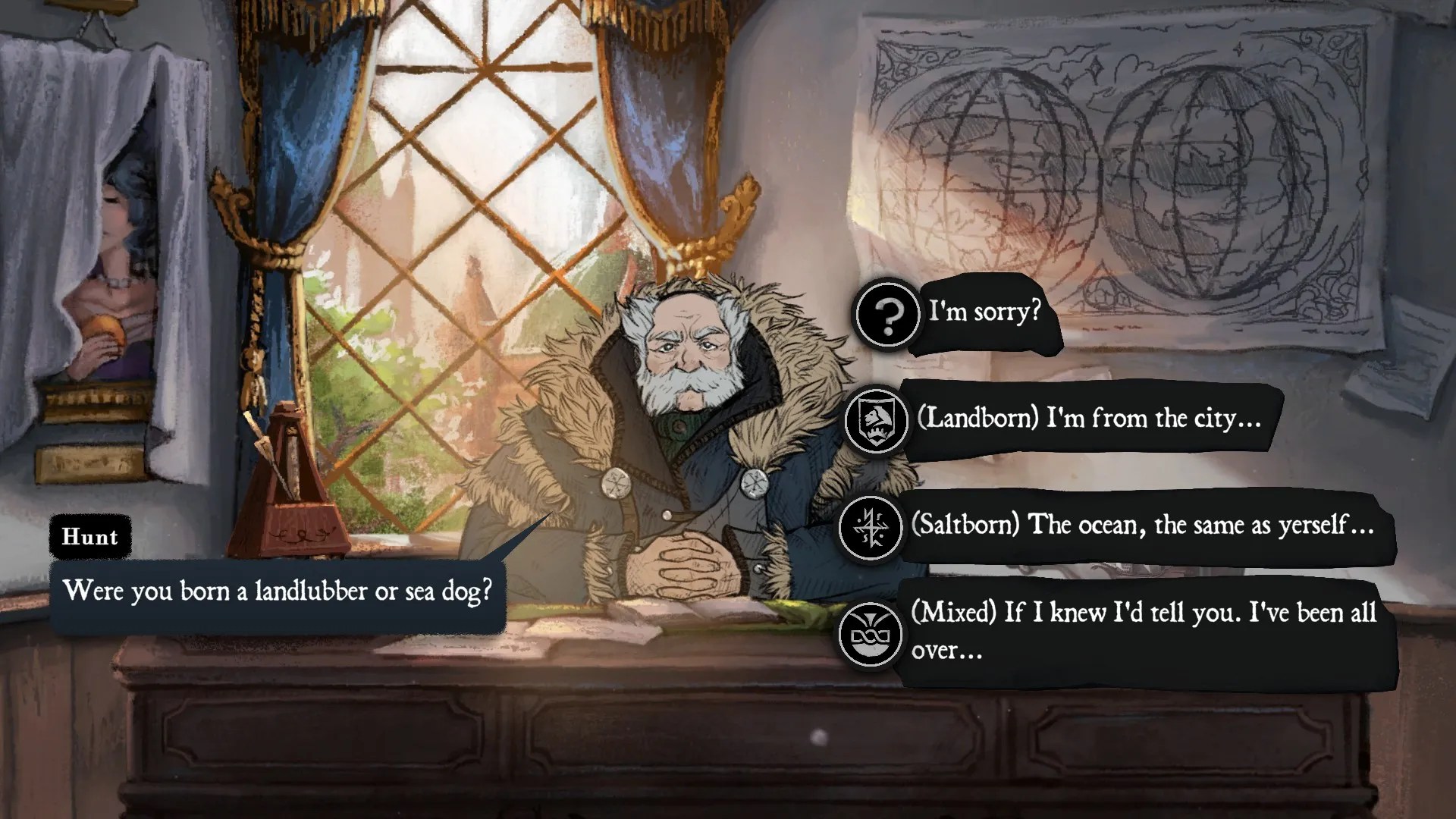
The setting of Citizen Sleeper meanwhile, could not be more different. Prior to the game, “you” as a person sold yourself to a company (for unknown reasons) and were put into some kind of cryo-sleep while the entirety of your collective identity, memories and personality were placed into an inorganic robot (well… Sort of?) body: a “sleeper”. Sleepers are second class citizens, essentially indentured robot slaves for the Corpo overlords of the distant future, whose existence is considered to be worthless because they’re just robots with fake memories. At the very start of the game however, your Sleeper body escape the clutches of the evil corporate overlords and runs away to a distant ring space station called Erlin’s Eye, now determined to make a new life as your own person and no longer just a copy of the real person still sleeping in cold storage.

Gameplay
Both games rely extremely heavily on day-by-day interactions to progress their respective stories. You perform actions, interact with the same characters and gradually progress their plot-lines and thus the overarching narrative. They are both heavily character-driven, although The Pale Beyond has a much more concrete central narrative, given that you have a definitive goal, I.e. reaching the polar regions and saving the last expedition, and so decisions made will always tie back in to the inexorable progress of your own expedition. Meanwhile Citizen Sleeper is a bit more directionless as it is up to you to gradually build your own new life on the Eye and that means there’s much less external pressure on the story (with one somewhat minor exception) and it’s more up to you how you will spend your time.
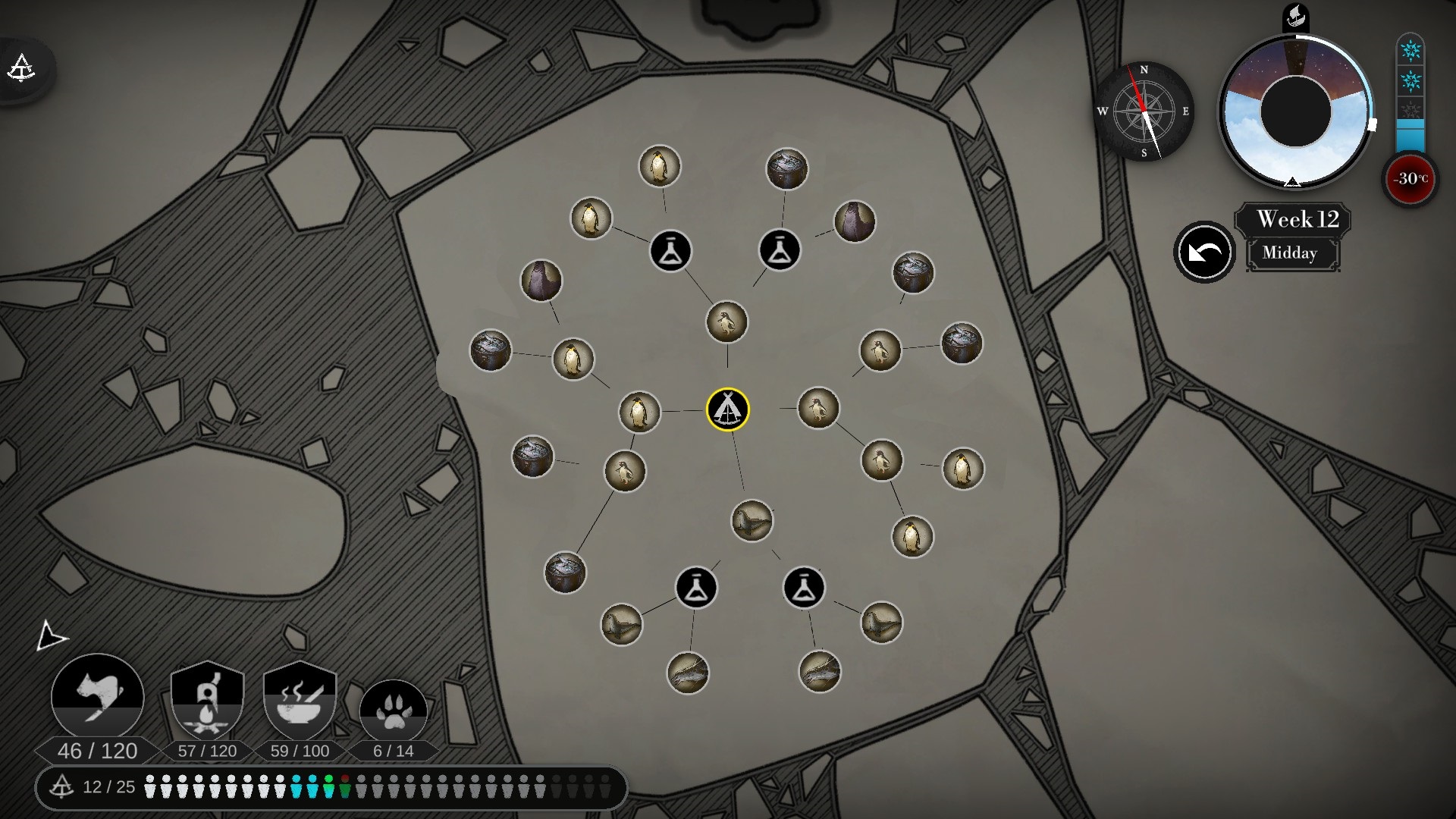
In The Pale Beyond, the focus is heavily on resource management and dialogue choices. Throughout the game you will go hunting, exploring, conduct experiments, fetch coal from the stores and cook dinner for your crew of ~20 individuals on the Temperence. As soon as the expedition starts, things start to go wrong and it becomes down to you to make the decisions about what provisions are used when. Sometimes you will need to use valuable supplies to maintain the morale of the crew at Christmas, but when you do, you might not have enough food for their normal rations the next day. You have to run a narrow edge of keeping their morale high, keeping them fed and keeping them warm, with dips in any of these things left untreated resulting in that individual dying PERMANENTLY for the rest of the run.

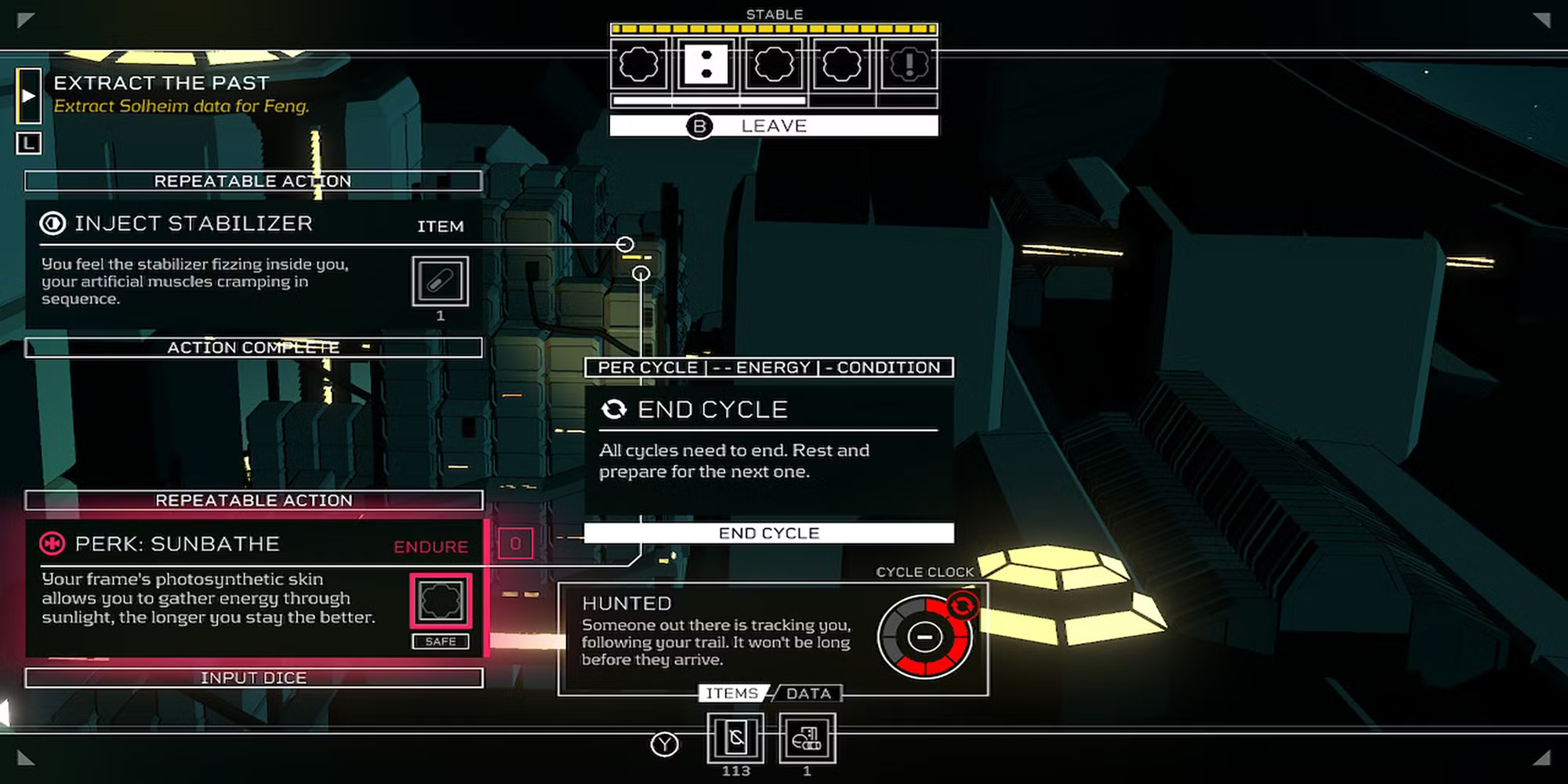
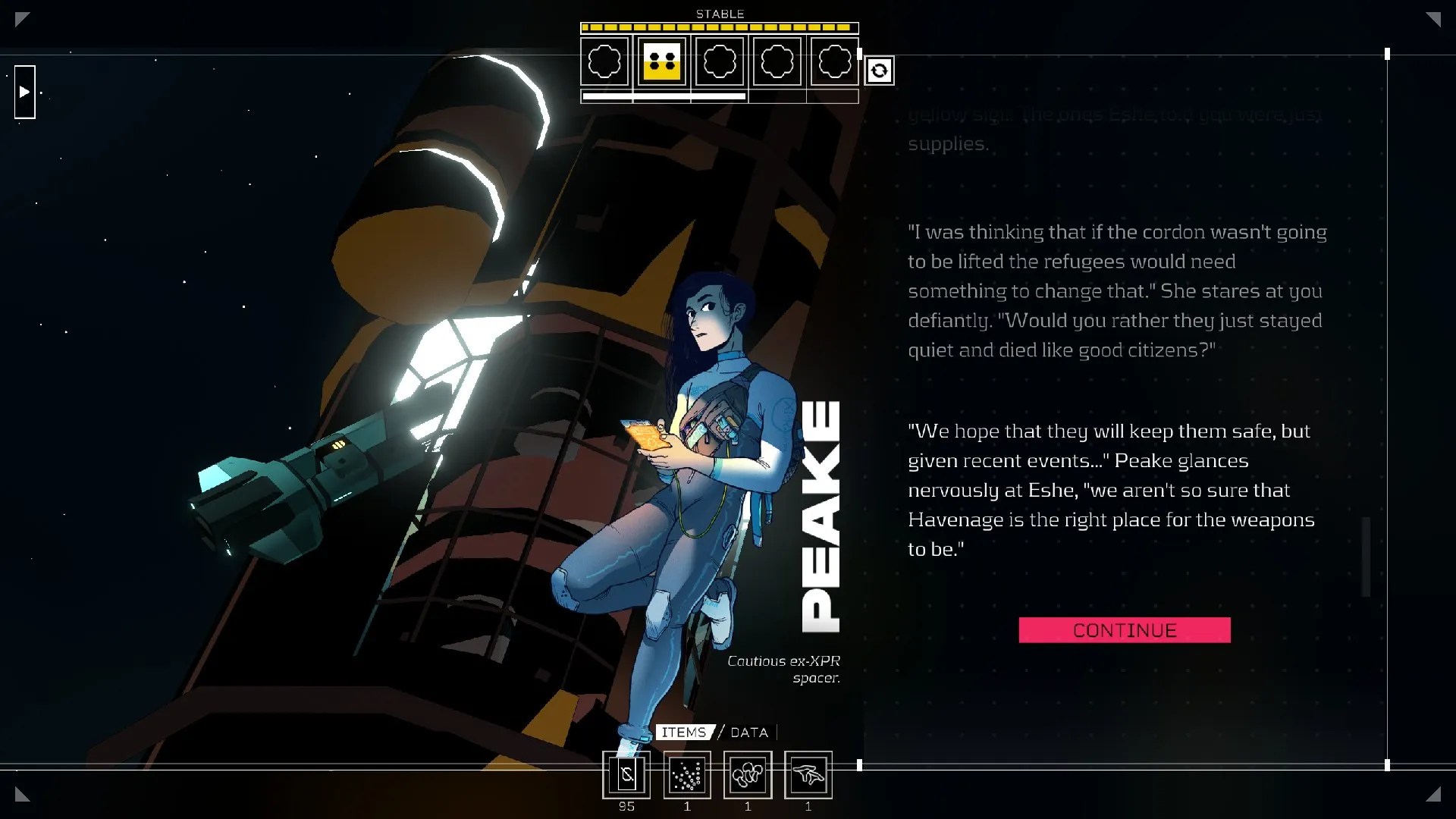
In Citizen Sleeper your resource management is your own personal energy, money and “condition”. Sleepers have been built with an inherent failsafe which makes them degrade over time without regular doses of a concoction which keeps their body from disintegrating. You also need energy from food (don’t ask me how that works) in order to function at your best. So, your primary goal is to set up a regular supply of the stabilizer and food, for which you need to do jobs in a gig economy across the Eye. You do this with a supply of 1-5 dice, the number depending on how stable your body is, where each dice represents one possible action you can take that day. You can use each die in performing jobs, scavenging, bartering, working at space bars, exploring the station, hacking terminals and more, with the number of pips on the dice generally representing the chance of success of the action. A 6 is a guaranteed positive success, and then the lower your dice go there is a rapidly increasing chance of a neutral result or even negative result of your action, e.g. a dice roll of 1 or 2 has a 50% chance of only a neutral outcome whilst also having a 50% chance of a negative outcome. As such the main gameplay of Citizen Sleeper is balancing where to use your best dice for when you NEED successes (such as using them to guarantee you make lots of money) whilst using your worst dice in the safer and less risky actions such as buying food or hacking.
This is because every action also has an inherent risk to it (safe, risky, dangerous) where the more dangerous it is on the scale, the worse the outcome is for you if you get unlucky with your dice. A negative outcome in a safe action might only produce the minimum money that you could have earned, whilst a negative outcome in a dangerous action might result in a drastic loss of your condition or energy.
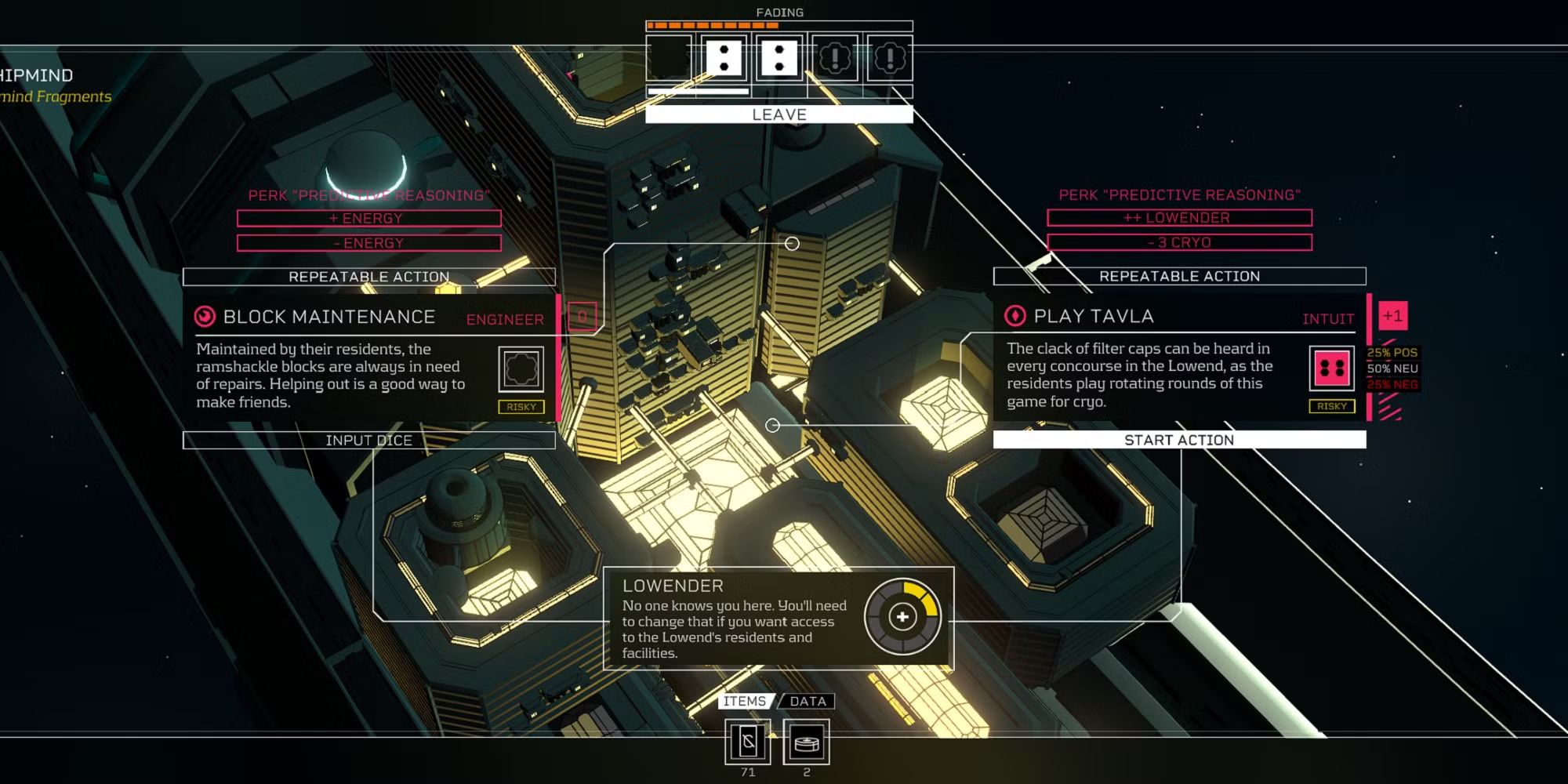
One thing which sets The Pale Beyond apart here is the difficulty. The balancing of dice and using the odds to obtain the most favourable outcomes in Citizen Sleeper is, frankly, not that challenging and is made much easier with the skill system (providing permanent buffs to certain dice rolls and even the ability to re-roll dice). Even when you are hit with negative outcomes, the vast majority of the time they are also not that punishing, so unless you’re being extraordinarily lackadaisical about using your worst dice in dangerous situations, you’ll be on top of things 90% of the time. There also is no REAL time-pressure in the game. The largest exception there is your ever decreasing condition, which means you constantly need to be earning enough money to buy stabiliser, and there are also some time sensitive missions which have to be completed in a certain number of days. But, again, unless you’re really being extremely careless, this is almost never an issue (one major exception there being the end-game DLC).
Meanwhile in The Pale Beyond, you are walking an absolute knife edge. You have to manage keeping your crew fed, warm and keep their morale up. You will also have to deal with day-to-day issues, arguments and squabbles and do so in a way that ensures that by the end of the game all of the main named characters are loyal to you. The game starts off slowly and easily enough, but if you are not absolutely tuned into the resource management FROM DAY ONE, then at some point people start dying. At some point you start making hard decisions and the crew starts to dwindle, and when one of your scouts or your engineers dies, there’s no getting new ones.
If you think that sounds punishing, you are absolutely correct. Particularly when winter hits. My first playthrough I had a decent store of food and fuel in the lead-up to winter with decent loyalty amongst my crew and thought I was doing well… Then winter hit. Everyone got frostbite almost overnight and within days my fully-crewed expedition was down to zero supplies and people began to perish. And for me, there was absolutely no way out of it.
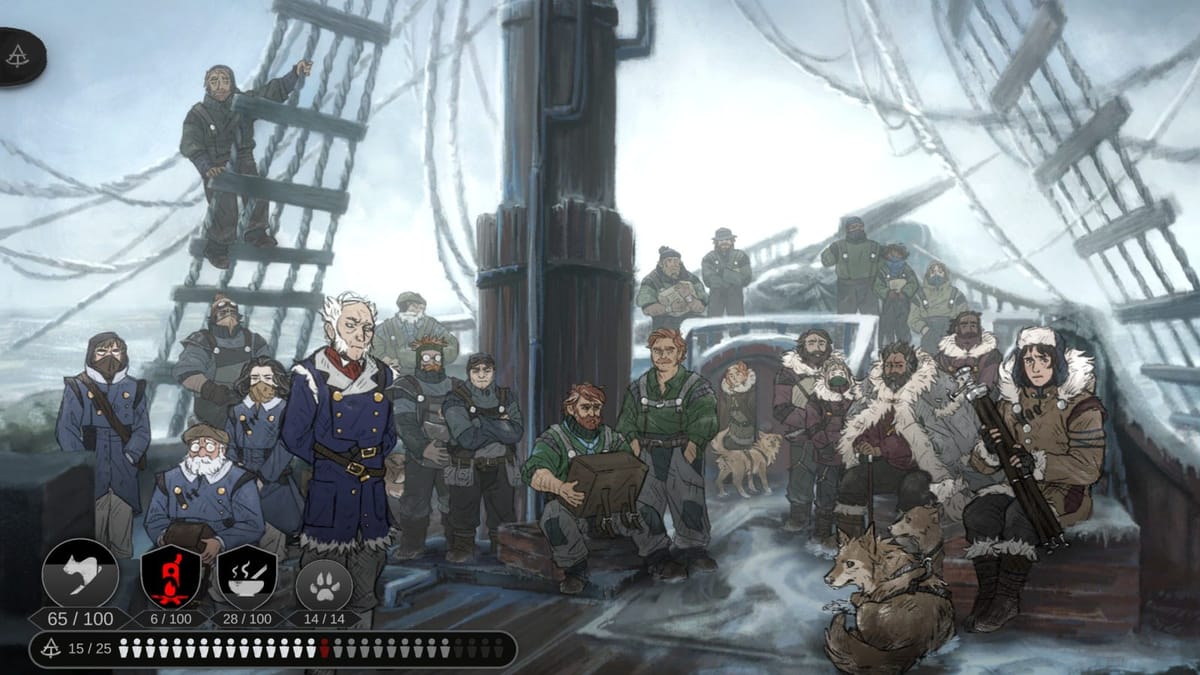
The way the game allows you to combat this is with its save system. In every single “run” you can go back to the beginning of each previous week of the expedition and start over from there to create a branching save tree system where you can go back and re-do a few weeks because you fucked up your relationship with the older Stoke brother and he’s now basically about to start a mutiny with the other seamen (hehe, seamen…).
For both games, their mechanics are a double-edged sword. Citizen Sleeper feels very relaxed 95% of the time and you broadly feel much more in control. However, this also means that really there isn’t that much challenge to be had. I very, VERY rarely felt like I had to make bold moves with low-value dice and risk it all on actions that NEEDED to be completed that day. Instead, it feels much more homey, chill and cozy, which is an odd vibe given the sort of dystopian, sci-fi setting of a lower-class backwater space station oppressed and ignored by the far-distant shining centre of galactic civilisation. This is something I’ll come back to later as well.
Then in The Pale Beyond, the difficulty means that EVERY, SINGLE, FUCKING, DECISION feels weighty. Like, godamn, the sailors are just singing a funny sea-shanty that makes fun of me as Acting Captain. But that’s causing discontent for my own second-in-command, and also what if it actually results in a breakdown of order? The crew desperately need more food but do we risk sending the scouts out on hunting expeditions for elephant seals which are guaranteed to cause injuries? Even small dialogue decisions can result in larger changes to the loyalty of different crew-members, and these are characters who become your friends! You don’t want to risk one of them going crazy in the winter and running off to their death to try and spare you one mouth to feed.

It’s fucking tense, it’s edge-of-your-seat decision-making, it’s tough and it relies on you being kind and sympathetic at times but also you have to be In Command. You have to make the tough decisions no-one else will, even the ones which you will agonise over after the fact. There are times you need to act and think fast, but I spent more time weighing the pros and cons of who to support in minor arguments in this game than I did over just about any decision in Citizen Sleeper.
Except of course you can also reload the save from two days ago to make sure that you actually can do the last two days properly and then you won’t be in this mess after all…
The issue of extreme challenge combined with regular checkpoints means that “save-scumming” becomes not just tempting but almost a necessity. Quite frankly, first time round, you are NOT going to get everything right and people are going to die. So, then it becomes about “well fuck you game, I’m gonna do this perfectly” and so if anything particularly negative happens you just re-do that day… This somewhat removes the sting of the difficulty but ALSO introduces an unfortunate element of tedium where it feels like you are somewhat compelled to repeat days and get the “perfect” outcome. And here’s the thing, it’s not “save scumming” because this is practically what the game WANTS you to do anyway.
This is of course assuming you’re not one of those insane folks who just raw-dogs an entire game and lets everyone die, just to see what happens at the end…
Like some kind of PSYCHOPATH.
Writing, story and characters
In both cases though, the mechanics are just the byproduct of being a video game. What we are really here for is the lovely, delicious, juicy N A R R A T I V E, in both situations delivered as a sort of visual novel. I.e. lots of text with semi-static backgrounds.
To be perfectly blunt, Citizen Sleeper had an uphill struggle against its writers to worm its way into my heart. From the very start of the game the prose is EXTREMELY florid and over-the-top sentimental. It feels a little bit like baby’s first Bladerunner, where every character is off going “I once had a life among the shining stars but then the deepest reaches of the bowels of hell reached out and crushed my iota of joy from my eyes and nothing but despair can live with the cruel rule of the corporations.” Meanwhile you’re standing there like “hey can you just be fucking normal for 2 seconds, bro?”

Likewise, the actual plot writing really tries dipping into the metaphorical and symbolical far too quickly. From the outset telling you how you are drifting along a river of blackness where the river represents the people of the space station and the blackness represents the walls around you. Stuff like that, y’know? It’s unnecessarily over-the-top and given that it hits you with it right out of the gate, it is little jarring and honestly, just kind cringe-worthy.
The other issue is something I touched on earlier. I mentioned how despite the aspirations of the Bladerunner-esque dystopian sci-fi theme, it felt much cozier and friendlier. At the very outset you are informed that Sleepers are basically second-class citizens. Little more than slaves and often despised by the general population. This ought to be particularly prevalent given that we are on an impoverished backwater station, a secluded place on the rim of galactic civilisation and order. Well, this is an attitude that just does not come across. All of the people you meet in the game are at absolute worst ambivalent towards you but mostly outright friendly and kind. I actually don’t think I recall a single instance of open discrimination towards me until actually very close towards the end of the game.
Rather than showing you what it insists is the case, Citizen Sleeper instead very quickly made the Eye feel like home. The people you meet are all lovely, kind and gentle souls. Admittedly there is a fair share of rough lives and sad situations, but invariably it all feels like a game of good people being good to each other.
I said that the game wormed its way into my heart and frankly this is actually why it did. Despite the nature of the supposed constant oppression and poverty which surrounds you on the station, and in spite of the lurid writing, the stories of the other people on the station are quite simply very HUMAN. The cook who wants to exchange stories over the one source of decent food on the place, the father trying to escape to the colonies to make a better life for his daughter, the botanist trying to care for the station’s gardens, the mechanic desperately trying to hold onto her ship berth. Even the AI who simply wants to be free and will help you protect yourself in exchange. Every character feels grounded, well-written and sympathetic. They treat you well and in response you want to do the same to them. The station becomes your home because of the people you work to help who are likewise helping you.

The decisions you make via dialogue usually felt fairly straightforward for me (and I THINK don’t actually have that much impact on the various arcs, only resulting in minor variation) but I also felt constantly engaged with each arc, despite them all being quite separate from the others. It also triggered some genuine emotional response in me when I finished them. Particularly those which would result in one of the several “endings”. Several of those ends, where you had to choose one way or another for an arc to end, maybe even leaving the station in the process, again quite simply felt genuinely human and emotional. For all that I roll my eyes at the style of writing, it is hard to deny that it is extremely evocative.
One very tiny aside there, I’m going to show my boomer side here, but I was not a fan of the deliberate choice to treat everyone as non-binary as default. Everyone is treated as a “they” until it was clear they are a “he” or “she”. I have no good reason for this dislike besides being stuck in my ways, but there it is, I simply am not a fan of it. I felt like Professor Oak half the time, yelling “are you a boy or a girl?!”
The Pale Beyond feels starkly in contrast with Citizen Sleeper then. While in Citizen Sleeper you constantly have to deal with seeing C-beams glitter in the dark near the Tannhäuser Gate from just about every paragraph, in The Pale Beyond, you are told it is cold and icy… Because it’s BLOODY cold and BLOODY icy. Sure there’s a few moments of beautiful light on the ocean and crystalline frost forming on moustaches, but it’s also much more solid, much more down-to-earth and quite simply less “metaphorical”. The game describes the way the world is, the way characters act, the way they give you wee side-glances when you make a decision which rankles with them.
Likewise, the characters also don’t precisely have stories which feel human, instead they just ACT like humans. They’re all good but flawed individuals who all want the best for the expedition and those under their care in their own way. The Doctor suffering from extreme imposter syndrome, the explorer who is past his prime, trying to do his best whilst also yearning for another chance at glory, the matter-of-fact engineer who cannae be arsed wi’ yer fucking politics and just wants to keep the boiler warm because that’s literally the only thing keeping us alive ya fuckin nonce.
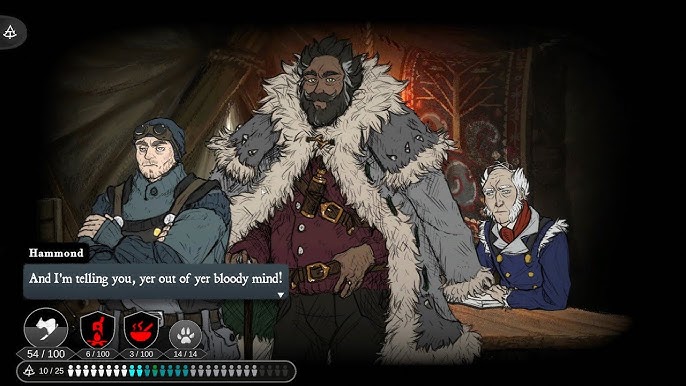
Where I felt like it was the stories and the endings of Citizen Sleeper which won me over, that feeling of people making their lives in their own ways in the deep blackness of space, in The Pale Beyond it is the characters themselves who carry it. They are by varying degrees, difficult to deal with because of their own foibles and opinions but also funny at times and heart-warming, particularly when you succeed in winning them over.
It also means that when you have to make decisions that do something which upsets them, it feels that much harder. As I said, you’re in charge, you HAVE to make the tough decisions. These are not just your friends, they’re also your subordinates and they are relying on you… But… They are ALSO your friends!
Where The Pale Beyond lost me a bit though was in its ending. I don’t wish to spoil so I will be as generic as possible, but while the game has actually got multiple different ending states (depending on who survives, the survivors loyalty towards you and then also several very important end-game choices) and these endings do feel satisfying, something about the nature of the ending just didn’t really make it click for me. It felt more intransient, a little too uncertain and also a bit too much like they were trying to leave it open for you to play the game again, rather than just ENDING the story.
I will as a additionally note here admit that I think I openly prefer the writing of The Pale Beyond to Citizen Sleeper. I liked the characters more, I like the dialogue more and I felt more connected to them through the decision-making and dialogue. However, Citizen Sleeper definitely inspired the larger emotional response from me. So, take that for whatever it means.
One final thing about the writing is its mesh with the mechanics. This is actually something I noticed in both games and may just be more of a “me” issue. Essentially, I felt it became much too easy to get into the rhythm of managing the day-to-day stuff (the resources/hunting and so-on in Pale Beyond and then the dice rolling in Citizen Sleeper), getting into that sensation of making progress through your tasks and your jobs, so that when you suddenly slip into dialogue or a story-segment one finds oneself clicking through it a bit too quickly in order to get BACK to the “fun” resource management. When it’s really meant to be that you click through the resource management in order to reach the plot… It’s a very silly thing which I don’t quite know how to reconcile, but I have noticed this in other games which rely on this sort of “visual novel” format before as well.
Put bluntly, I suspect this is a problem caused by the visual novel format and would be solved by making the reading sections more visually stimulating. Rather than relying on still frames actually having animation or something like that (or in the case of Citizen Sleeper having fucking ANYTHING to look at), just to break the “tedium” of reading.
Aesthetic
Both games broadly have a similar style of visuals where the majority of the game is played in a top-down view of the setting, whether this is the base-camp or ship of Pale Beyond or the relatively constant presence of Erlin’s Eye.
Citizen Sleeper uses a technopunk, Bladerunner-esque aesthetic. There’s influence of Asian culture in the appearance of clothes and individuals, along with cybernetics and the like. The station meanwhile has the combination of looking almost like hard sci-fi, as opposed to that slightly dystopian feeling, which gives it a fairly grounded vibe. On the other hand, many of the character designs do look kind of slightly over-designed. It’s clearly just an aesthetic choice, but it’s noticeable enough that so many of the characters have such an odd amount of bells and whistles stuck to them.
This is primarily during dialogue, with the characters only ever appearing as still frames, and during the actual gameplay you just rotate around the Eye itself. One thing which does bother me a bit here is the UI of the game, where it is never immediately obvious what different icons represent. It’s usually easy enough to learn these things after half an hour of playtime, but even towards the end of the game I would regularly have to click an icon to make sure it wasn’t what I was after before trying again with another one.
The game really is also as I mentioned, unfortunately very static. There is very, VERY little in the way of animation and even major characters usually only have one static image to represent them (not even with changes in expression or stance to reflect mood and tone). This also means that a lot of Citizen Sleeper is, quite honestly, just relatively boring to look at.
Much like its writing, the Pale Beyond feels, again, more grounded in reality in just about every way. There is perhaps, a slight fantastical element to certain aspects of it (to make it clear that this is not meant to be historical in any way), but for the absolute most part all characters, backgrounds and visuals have less artistic “flair”, shall we say, but also feel much more practical and REAL.
Even with that grounding in “reality” there are still moments of beauty within the game, where it can look quite simply NICE with the Temperance sailing through frosty arctic waters. Characters also are distinct and while they may not be as visually exciting as the designs of Citizen Sleeper, they do instead have small animations to demonstrate mood, making them that tiny bit more engaging. The game also incorporates very minor elements of animation, not just in character pictures but in the game itself, meaning that there is often simply MORE to look at.
I also think that not only is there more engaging stuff in The Pale Beyond, but again, I simply prefer the somewhat less overdesigned and less visually cluttered aesthetic they chose over that of Citizen Sleeper.

Music and sound design
Again, both games take quite different approaches to their sound design, although in both cases the similarity is that they are fairly minimal. The Pale Beyond’s soundtrack is about as minimal and understated as you can get. The game often seems to focus on the sounds of the ship moving, ice creaking, dogs barking and waves crashing rather than music and in a way this feels very deliberate, it highlights the bleakness of your surroundings, the desperation of the expedition. The music it does have felt very minimal, highlighting scenes but never really overpowering, something which was certainly helped because it felt like it primarily relied on acoustic sounds, which might have been heard on real sailing ships. To be blunt though, the vast majority of it does not stand out in my memory.
The sea shanty was kinda fun though…
Citizen Sleeper is every bit as minimal but in the other direction. It has a full soundtrack of tunes which are primarily sort electronic music, vaguely techno-y but not high energy EDM. It’s the perfect soundtrack for the aesthetic they are going for, the cyber/technopunk feelings along with the sense of loneliness that the game seems to want to inspire. In this instance they really did kind of nail that Bladerunner feeling. The emotional moments are also emphasised fairly well through the music and it’s just all quite effective. It’s actually a bit of a testament to it, that I think the music of the game is a big part of what makes it feel quite so easy to just keep playing through it. It provides a constant backdrop which helps push you forwards, not necessarily because it’s pulsing and pounding and exciting, but it’s just nice to listen to.
Conclusions
At this point I probably sound extremely down about Citizen Sleeper, something I genuinely hadn’t intended at the outset of writing this (if anything I feel in hindsight I’ve done it a disservice by writing about it at the same time as the Pale Beyond).
It is probably abundantly clear that I prefer The Pale Beyond. I think the art direction is not only more visually stimulating but quite simply better. I think the challenge of the game, while it comes with its own cross to bear makes it more exciting than Citizen Sleeper. I think the writing feels more enjoyable and the decisions feel more weighty. As much as I did several times repeat encounters and weeks in The Pale Beyond, it felt tense, exciting and like I was genuinely in command of an arctic expedition with lives on the line. It made me care about characters and want to win their loyalty, not just for the mechanical reasons. Where Citizen Sleeper only barely edged it out was that it provoked a more emotional and considered response from me at the end of the game.
This is however not to say that Citizen Sleeper is bad. Quite the opposite in fact. It is still a really excellent game in its own way. Despite the writing being a bit overly floral, it is about stories which feel genuinely human and which you WANT to see brought to their conclusion. You feel a connection with the characters and even with the space station. The gameplay is a bit lacklustre but it’s just there as a vehicle to drive you through the story and was clearly not intended to be something to keep you on the edge of your seat. I will admit that I wish there had been more to look at and that what was there was also a bit clearer in style, but they also picked a very unique aesthetic which absolutely makes the game stand out in my memory and when combined with the soundtrack it was nevertheless capable of being an enjoyable experience to play through. I don’t regret one second of my time playing the game and heartily recommend it to story afficionados.
The difference simply is that gun to my head, I’d say you should go for The Pale Beyond instead. Even though the none of the music really stands out and it doesn’t take many creative liberties in terms of its style, I personally just quite liked the grounded aesthetic and vibe they went for. I thought the characters felt much more like real people with their own foibles and quirks and, quite simply I felt like my decisions and my impact as the player was that much more important. The only place I don’t really know where I stand is on its save system.
Citizen Sleeper rating: 71
Verdict: Sale
| Pros | Cons |
| – Exceptionally human world and writing which will make you simply care about the inhabitants of the world – World building is effective, developed slowly and gleaned in dribs and drabs across the game – Low-fi-esque music which makes there feel like a constant flow – Several enuinely emotional and emotive moments -Just a nice game about nice people | – Writing really needs to get a grip and is a tad over-the-top with how florid its language is – Character portraits are a tad overdesigned for my taste – Visual novel format works decently enough, but with the black backgrounds, it can be quite uninteresting to look at and this makes more dramatic moments suffer |
The Pale Beyond rating: 79
Verdict: Recommended
| Pros | Cons |
| – Incredible writing and plot, characters are believable and sympathetic everything about it is just bloody compelling – Super weighty decision-making where every single choice, from what resources to prioritise and what to put on your sandwiches feels important – Very lovely visual design and aesthetic which is both easy to understand visually whilst also just largely being quite pleasant to play – Winning over characters and earning their loyalty feels fucking great | – Save-tree system seems to not only encourage but maybe even outright suggest save-scumming – Ending is a tad underwhelming due to it seeming somewhat “undefinitive” – Bloody hard… |

 MMGaming.net